

Snow changes two things at a tower, and neither of them is the flying. It lies on the runways, where it takes away the grip an aeroplane needs to stop, and it lies on the aeroplanes, where it takes away the clean wing an aeroplane needs to fly. The first puts the runways on a schedule of closures while the ploughs clear them. The second sends every departure to the de-ice pad before it may go, with a clock running from the moment it leaves. This chapter works through both at Bayview, on a day of light snow at two below freezing.
Snow on the runway
A runway with snow on it still works, but an aeroplane needs more of it to stop, and a crosswind it would take on dry pavement can push it off the side. Pilots describe what they felt on the landing roll in fixed terms: good, medium, poor or nil. Nil means no braking worth the name, and nobody lands or takes off on a runway reported nil. The airport operator measures the surface too and reports runway condition codes, a number for each third of the runway, which the tower puts on the recording as it receives them.
When the reports start to come in, or the weather is the kind that makes them likely, the tower says so on the broadcast:
When runway braking action reports are received from pilots which include the terms "medium," "poor,"or "nil," or whenever weather conditions are conducive to deteriorating or rapidly changing runway conditions, include on the ATIS broadcast the statement "Braking Action Advisories are in effect."
From then on every arrival and departure hears the latest braking action for its runway, early enough to use it. At Bayview the recording reads it after the weather: braking action good just after a runway has been ploughed, then medium, then poor as the snow builds. Light snow takes about half an hour to take a ploughed runway to poor; HeavyUnited Four Heavy, Bayview Approach.A wake-turbulence class carried in the callsign of aircraft able to take off at 300,000 pounds or more, because the wake they leave behind is a hazard to whoever follows.Open in the glossary snow does it in under ten minutes. A change of braking action is a new recording and a new letter, like a change of wind.
Closing a runway for the ploughs
The condition of the runways is not the tower's to decide. The airport operator watches it, measures it and clears it, and only the operator can close a runway:
note1. Legally, only the airport management/military operations office can close a runway.
What the tower owns is the runway while anyone is on it. So a snow closure is a conversation. The operator's snow team asks for the runway when the braking has gone poor; the tower closes it when the traffic allows, stops sending aircraft to it, and clears the ploughs onto it. At Bayview the team is Snow one, three trucks out of a barn west of the field, and they ask every three minutes until they get the runway.
Bayview Tower, Snow one, braking action poor runway two five right, request runway two five right closed for snow removal.
Snow one, runway two five right closed for snow removal, proceed.
Runway two five right closed, Snow one on the way.
The word proceed is the clearance onto the closed runway. Without it the trucks stop at the runway's hold line and ask. Every other runway on their way is still yours to clear, one crossing at a time, exactly as for an aeroplane; at Bayview the barn is on the far side of three three, so the convoy asks to cross it on the way out and on the way home.
The timing is the judgement. A runway closed with an arrival on short final sends that arrival around, and the approach controller stops sending more while the landing runway is shut. A runway left open to finish a departure queue goes on getting worse, and past poor it reaches nil, when no crew will use it at all. The good moment is usually the gap after one departure and before the next arrival is inside ten miles. The ploughs at Bayview take about seven minutes from the call to an open runway: the drive out, one pass down the full length side by side, and the drive clear. When the last truck is off they report it, and the runway opens with the braking action good.
Bayview Tower, Snow one, runway two five right snow removal complete, braking action good, all vehicles off the runway.
Telling the pilots
A closed runway goes on the recording at once, and so does the braking action on the runways that stay open. The manual lists snow among the airport conditions a pilot is owed in time to use them:
Issue airport condition information necessary for an aircraft's safe operation in time for it to be useful to the pilot. Include the following, as appropriate:
Braking conditions caused by ice, snow, slush, or water. Snowdrifts or piles of snow on or along the edges of the area and the extent of any plowed area.
In practice that is the braking action with every landing and takeoff clearance, the closure with any taxi instruction that would have used the runway, and a word to an arrival about to be moved to another runway while one is being ploughed.
De-icing
An aeroplane with snow or frost on its wings does not take off. While it snows, every departure goes through de-icing first: trucks spray the aeroplane with heated fluid that melts the snow off, and usually a second, thicker fluid that keeps new snow from sticking for a while. That while is the holdover time. It depends on the fluid and on how hard it is snowing: at Bayview, about twenty minutes in light snow, twelve in moderate and six in heavy. The clock starts when the spraying stops. If the aeroplane is not rolling before it runs out, the crew will not go, and it has to be de-iced again.
Bayview de-ices on a pad beside taxiway alpha, between charlie and the end of two five right: two bays side by side, entered from the west and left to the east, like a car wash. The pad crew spray the aeroplane; the tower's part is getting it there, getting it away, and keeping the departure sequence short enough that nobody's holdover runs out in it.
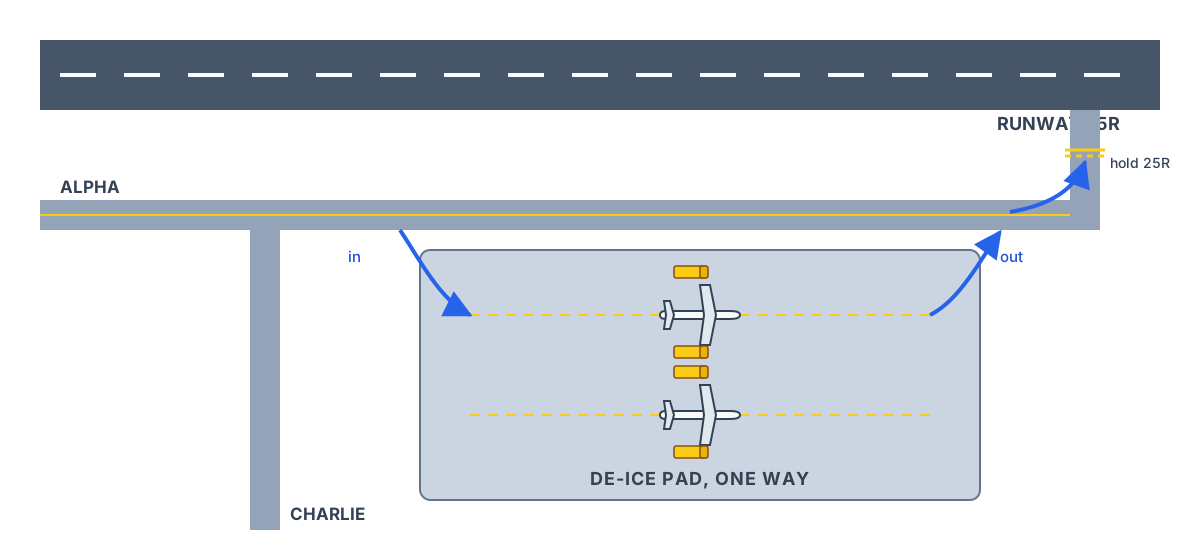
With the ground combined the departure asks for it at the ramp, and the taxi to the pad is yours. A taxi to the runway is refused until the aeroplane has been de-iced.
Bayview Tower, Delta one two zero, at the ramp with information Whiskey, request taxi to the de-ice pad.
Delta one two zero, taxi to the de-ice pad via bravo, charlie, alpha.
Taxi to the de-ice pad via bravo, charlie, alpha, Delta one two zero.
The spray takes a few minutes, longer for a bigger aeroplane. When it is done the crew calls with its holdover time, and the taxi to the runway is a short one.
Bayview Tower, Delta one two zero, de-icing complete, holdover time one two minutes, ready to taxi.
Delta one two zero, runway two five right, taxi via alpha.
From then on the departure's strip counts the holdover down in whole minutes. Sequence the de-iced departures ahead of the ones still on their way to the pad, and do not line an aeroplane up behind a long queue of arrivals with two minutes left on its fluid. If the clock does run out before the aeroplane is in position, the crew tells you, and the pad is the only place it can go.
Bayview Tower, Delta one two zero, holdover time expired, we need to return to the de-ice pad.
With a separate ground controller the taxi to and from the pad is ground's, and what reaches you is a departure at the Holding pointThe marked position at the runway entrance where a departure waits for its clearance. Crossing the marking without one is a runway incursion.Open in the glossary with its holdover already running. The strip tells you how long you have.
Working the day
A winter shift is a trade between the runways and the queue. A closure costs the field one runway for several minutes; a runway left too long costs it the runway altogether. Every departure costs a trip to the pad, and a departure that waits too long costs a second one. The habit that keeps it working is looking ahead: know which runway is going poor next and close it in a gap, and release de-iced departures before their clocks, not after.