

Air traffic control exists to keep aircraft from hitting each other. That is the whole reason for the radio calls, the radar scope, the vectors and the sequencing you will learn in this book. Every aircraft in the system is talking to one controller at a time, and that controller is responsible for keeping it clear of everything else while still getting it where it is going.
This chapter explains what the system is for, how the work is split between controllers, and which part of it you are going to do.
What air traffic control does
The job has three parts: separation, sequencing and flow.
- Separation is the rule you never break. Aircraft are kept a defined minimum distance apart, vertically or laterally, at all times.
- Sequencing is the work of turning several inbound aircraft into one orderly line for the runway, with each aircraft in its place and the right spacing between them.
- Flow is the longer view. Traffic has to keep moving, because a delay in one place spreads to every place behind it.
Only separation is about preventing collisions. Sequencing and flow are about doing the job efficiently. A controller can keep everything apart by slowing every aircraft to a crawl, but that only moves the problem downstream, and the airport behind you fills up. The rulebook American controllers work from, FAA Order JO 7110.65, states the purpose in its opening paragraph:
The primary purpose of the ATC system is to prevent a collision involving aircraft operating in the system.
Provides a safe, orderly, and expeditious flow of air traffic.
Safe comes first, then orderly, then expeditious. When you have too much to do at once, the rulebook also says what to do first:
Give first priority to separating aircraft and issuing safety alerts as required in this order.
Remember this rule. Later chapters give you a dozen things to do at the same time, and this is how you decide the order.
Tower, Approach, Center
No single controller works a flight from gate to gate. The sky is divided into volumes, each one owned by a single position, and a flight passes from one position to the next as it moves through them.
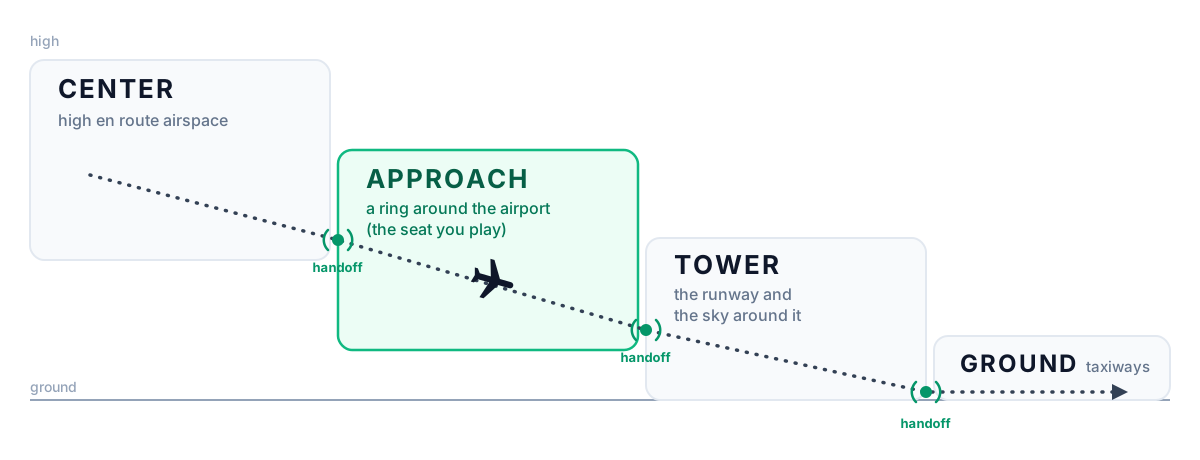
For an arriving flight, the sequence of owners is this:
- Center owns the high, wide en route airspace between cities. It starts the descent and points the flight toward its destination.
- Approach owns a ring of airspace around a busy airport, roughly the lowest 10,000 feet within 30 or 40 miles of the field. It threads the descending flight through everyone else and delivers it lined up for the runway.
- Tower owns the runway and the sky immediately around the airport. It clears the flight to land.
- Ground owns the taxiways and guides the flight to its gate.
Departures go through the same chain in reverse. Each transfer between positions is called a handoff. The sending controller coordinates it, and the pilot is told which frequency to call next. The rulebook has a firm condition on when a handoff may happen:
Transfer control of an aircraft only after eliminating any potential conflict with other aircraft for which you have separation responsibility.
In other words, you do not pass a problem to the next controller. Chapter 6 returns to this rule when you hand your first arrival to the tower.
The position you play
This handbook trains you for two of these positions. Chapters two through nine put you in the approach seat, which is the middle link in the chain and the busiest one. Chapters ten through thirteen move you to the tower cab, where the runway itself is your responsibility. Approach comes first because the habits it builds carry over: radio discipline, a regular scan of the traffic, and a plan you keep in your head and update as things change. The tower runs on the same habits.
In both seats your airport is Bayview International, airport code KBAY. For now you are Bayview Approach, and your frequency is one two four point six.
Your neighbors do not change. Cascade Center sits above and around you; it feeds you arrivals and takes your departures. Bayview Tower sits below you and owns the runways, which are two five right on most days and three three when the wind swings around. Every aircraft in your sector is talking to you and to nobody else, so every problem in that sector is yours to solve.
Approach is where the traffic converges. Center mostly handles aircraft that are flying straight and level with plenty of room between them. Tower mostly handles one runway event at a time. Approach takes a dozen aircraft that are all descending or climbing toward the same few miles of sky and has to fit them into a single safe sequence, in real time, by voice.
The other end of the radio
Every instruction you give is carried out by a pilot in a cockpit with a workload of their own. You never see them, only hear them, and it helps to know what their side of the conversation looks like. Pilots fly by the AIM, the pilot-side manual that matches your rulebook, and it shapes how they will talk to you and what they expect to hear back.
Some things are always true on the other end of the radio:
- Pilots cannot see the traffic picture. You have the scope; they have windows and instruments. When you tell a pilot that traffic is two miles away, it may be the first they have heard of it.
- Pilots are busiest at the moment you need them most. On arrival they are descending, configuring the aircraft and briefing the approach. An instruction that arrives late arrives in a loud cockpit.
- Pilots must acknowledge your instructions, and you must listen to what they say back. This closed loop is called the ReadbackThe pilot repeating a clearance or instruction back so the controller can verify it was received correctly.Open in the glossary, and it is the main safety net in the system. Chapter 3 spends most of its length on it.
- Pilots can refuse. If an instruction is beyond what the aircraft can do, or against a rule they fly under, the pilot says UnableUnable.I cannot comply with that instruction. Information, not defiance; it forces a new plan, fast.Open in the glossary, and you plan around it.
This is what the loop sounds like the first time an arrival calls you:
Bayview Approach, American Two One Five, descending through one one thousand for ten thousand.
American Two One Five, Bayview Approach. Expect runway two five right.
One phrase you might expect is missing from your reply. Radar contactAmerican Two One Five, radar contact.I have identified you on my display and will provide radar flight following. Said when identification is established, and the pilot can stop making position reports.Open in the glossary means a controller has identified the aircraft on the display and is providing radar flight following. It is said once, by the first radar controller to identify the flight, and this arrival heard it from Center long ago. Identification travels with the handoff, so you answer with your position and what the pilot should expect. From this check-in until you pass the flight to the tower, it is yours. You do not need to decode the rest of the call yet; chapter 3 takes every phrase apart. For now, notice the order of it: who is being called, who is calling, and what the caller wants you to know.
In the Sim
In ATC Simulator you work this position: Bayview Approach, with the radar scope in front of you and one voice frequency, taking arrivals from Cascade Center and departures climbing off two five right. The tower is in the game as a separate shift. You choose the seat in the ready room, and chapters ten through thirteen are the ones that train you for the cab. The boundary of your sector is drawn on the scope as the video map polygon. Traffic appears where the real position's agreements with its neighbors say it should, and your responsibility ends where the polygon does.
Everything is spoken. You give your instructions over push-to-talk the way the real position does, pilots read them back in their own voices, and you hear the other traffic on the frequency around you. Separation, sequencing and flow are also how you are scored. The game measures whether your aircraft stayed apart, how clean your sequence to the runway was, and how much delay you added or saved.
Where the sim differs from the real job, each chapter says so in this section. The largest difference is one to know from the start. A real approach controller works inside a web of telephone lines, supervisors and neighboring sectors that a single-player game does not reproduce. The sim keeps the parts of the job that happen on your frequency and your scope. That is most of the job, and it is the part to learn first.