

Every arrival you work follows the same sequence of steps. The flight checks in on your frequency and becomes yours, and from then on each instruction you give moves it toward one outcome: a stabilized position, on speed and on altitude, from which the turn onto final can be made. The last three chapters gave you the pieces: the airspace you own, the words on the radio, and the way an arrival is built before it reaches you. This chapter puts those pieces to work, in order, on a single flight.
Take the handoff
The workflow begins when a flight checks in on your frequency. Cascade Center has just handed it to you, and the pilot's first call tells you who they are and roughly where they are.
Bayview Approach, Delta Nineteen, descending through one seven thousand for one one thousand.
Delta Nineteen, Bayview Approach, expect runway two five right.
Your reply does two things. It tells the pilot which runway to plan for, and it marks the point where the data block on your screen becomes the thing you work from. The data block is the small tag that follows the aircraft symbol and shows its altitude, groundspeed and route. From this call until you hand the flight to the tower, every change in that data block happens because you said something on the radio.
This is also the moment to build the picture in your head. Note who else is nearby, what altitude this flight is at, and how much room it has before it needs to start down. The rest of the chapter depends on this first step being done carefully. A controller who loses track of an aircraft at check-in spends the rest of the session catching up.
Establish where it is going
Before you give the aircraft any instruction, know what you are aiming it at. Bayview uses two five right on most days and three three when the wind swings around. The runway in use decides most of what follows: which way you eventually turn the flight, how much room you need, and which fixes matter.
The flight already has a routing, usually the STAR it flew in on, which carries it toward fixes such as RONBY or ULPEX. Chapter four covered how that routing is built and read. The question here is simpler: whether this flight needs your help now or can keep navigating itself for a while. An aircraft well out on its own STAR and clear of other traffic may not need an instruction from you yet. An aircraft converging with another arrival, or arriving faster than the aircraft around it can absorb, needs an instruction at once. Making that judgement before you key the microphone is what keeps you ahead of the traffic.
Descend the aircraft
Altitude is usually the first thing you change, because a descent takes distance and the distance available only shrinks as the flight gets closer to the airport.
Delta Nineteen, descend and maintain five thousand.
Descend and maintain five thousand, Delta Nineteen.
Plan the descent before you issue it. A jet descending at a comfortable rate needs roughly three miles of ground track for every thousand feet it loses. A flight ten thousand feet above its target altitude therefore needs about thirty miles to get there without either diving or dragging the descent out. This three-to-one ratio is the rule of thumb behind almost every descend and maintain you issue. Look at how far the flight has to travel before you need it down, compare that with how far it has to descend, and you know whether you are ahead of the aircraft or behind it.
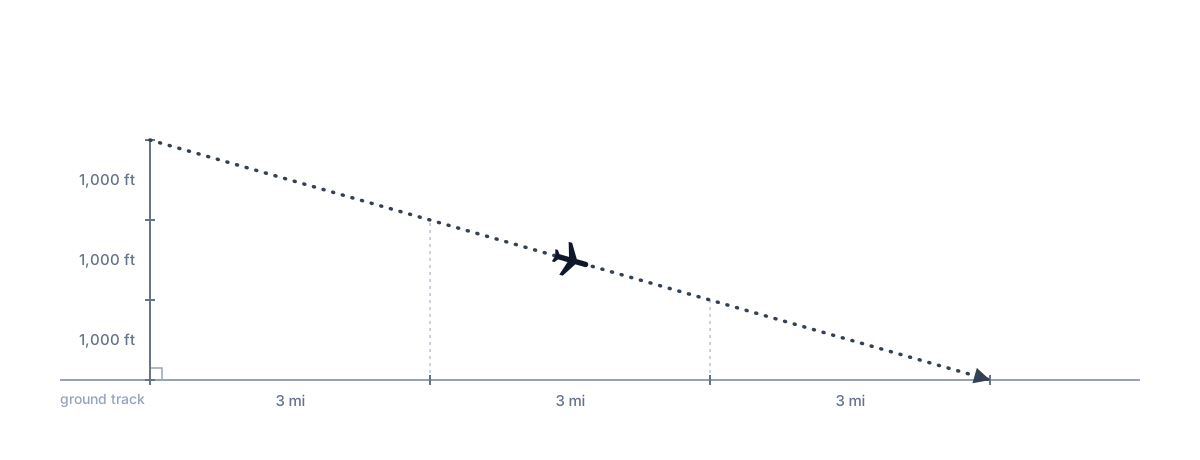
Most descents need nothing more than the plain instruction above. Crossing restrictions and timed descents are for the aircraft that need them. A plain descend and maintain, issued early enough to leave the three-to-one room, is the normal case.
Headings and direct-to
A descent puts the flight at the right altitude. To put it in the right place you give it a heading. In FAA terms this is vectoring: the aircraft leaves its own navigation and flies the headings you assign.
Delta Nineteen, turn left heading two five zero.
Left heading two five zero, Delta Nineteen.
The rulebook's phraseology for the instruction is short:
PhraseologyTURN LEFT/RIGHT HEADING (degrees).
Two things make a heading instruction work well. The first is the turn itself. An aircraft rolls into a bank and holds it, and at arrival speeds a jet turns a little more slowly than the textbook standard rate, because the autopilot holds a limited bank angle and the turn rate follows from that. A small heading change and a large one begin in about the same time and finish at very different times, so plan around how long the turn will take. That matters more than the number of degrees. The second is leading the turn. When you want an aircraft to roll out on a specific course or intercept a specific line, call the turn while it still has room to swing through its own turn radius. If you wait until the aircraft reaches the line, it has already overshot by the time the turn is complete.
Direct-to is the shortcut. Once a flight is past the point where vectoring served a purpose, clearing it direct to a fix returns navigation to the aircraft's own systems and takes that flight off your list of headings to manage.
Delta Nineteen, proceed direct MIKSA.
Direct MIKSA, Delta Nineteen.
Use it whenever it is available. An aircraft flying itself to a fix is one less heading for you to track and update.
Slowing an arrival
Speed is one of the most useful tools you have. Slowing an arrival at the right time changes the spacing between two aircraft without moving either of them off its route.
Keep speed adjustments to the minimum necessary to achieve or maintain required or desired spacing. Avoid adjustments requiring alternate decreases and increases.
Adjust as little as you need to, and stop adjusting once the spacing is right. Repeatedly speeding an aircraft up and slowing it down again adds workload for the pilot and transmissions on your frequency without improving the spacing.
Delta Nineteen, reduce speed to one seven zero knots.
Reduce speed to one seven zero knots, Delta Nineteen.
The rulebook also sets floors on how slow you can ask an aircraft to fly, so that an arrival is never assigned a speed its category cannot hold. Below ten thousand feet a jet arrival is normally assigned no less than two one zero knots. The floor comes down only close to the airport:
Assign a speed not less than 170 knots when the aircraft is within 20 flying miles of the runway threshold.
The one seven zero assigned to Delta Nineteen above is allowed because that flight is already inside those 20 miles. Further out, two one zero is as slow as a jet has to accept, and propeller aircraft have lower floors of their own.
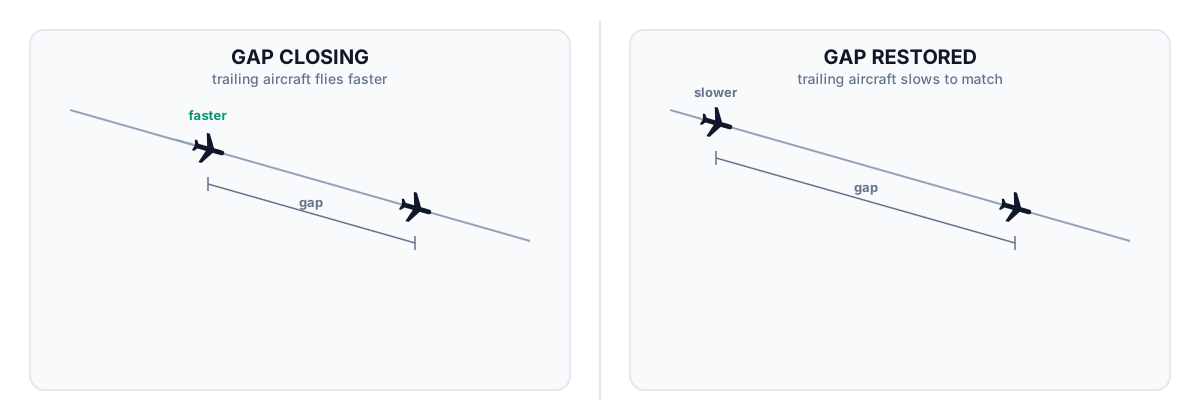
Speed changes take time. A jet in a clean configuration takes longer to slow than one already partly configured for landing, and a HeavyUnited Four Heavy, Bayview Approach.A wake-turbulence class carried in the callsign of aircraft able to take off at 300,000 pounds or more, because the wake they leave behind is a hazard to whoever follows.Open in the glossary aircraft takes longer than a light one. The earlier you issue a reduction, the smaller it needs to be. This matters most when one arrival is closing on another ahead of it. By the time the closing gap is obvious on the scope a speed instruction is already late, so slow the trailing aircraft while the gap is still closing.
Position it for the approach
Everything in this chapter is aimed at one place: a flight that arrives at its handoff point on altitude, on speed, and on a heading that sets up cleanly for the turn onto final. That is the target for every arrival you work, whether it takes two instructions to get there or ten.
Chapter six picks up at this point and covers the vector onto the final approach course, the approach clearance itself, and the handoff to the tower. Chapter seven covers what changes when this is not the only arrival on your frequency and you are building a sequence. For now, the measure of a well-controlled arrival is whether it reached the handoff point ready, with no late correction to its altitude, speed or track in the last few miles.
In the Sim
In ATC Simulator the heading command is the one you use most. It is modelled on the real thing: when you issue it, the aircraft rolls into the turn and holds a steady bank until it reaches the new heading, the way a real autopilot does. It does not snap onto the new course. Each aircraft also carries a predicted-track vector, a short line that projects where the flight will be a short distance ahead. Reading it while you plan a turn or an intercept shows you a bad lead before the turn is complete.
Descent and speed both vary from one aircraft to the next. Two flights of the same type will not descend or slow at the same rate, so treat the three-to-one rule and the speed guidance above as starting points and watch what the aircraft in front of you does.
The sim's video map is the polygon that marks your sector and its terrain features, and as far as the game is concerned that polygon is the terrain. Below a minimum vectoring altitude there is no separate elevation model checking your vector against the ground. If you vector an aircraft too low in a place the map does not account for, the sim will not catch the mistake the way a real MVA chart would. This is a deliberate simplification, and you should keep it in mind when you plan a low vector.