

Departures are the more straightforward half of the tower's work. The aircraft is on the ground, it is not converging with anything, and it will wait at the Holding pointThe marked position at the runway entrance where a departure waits for its clearance. Crossing the marking without one is a runway incursion.Open in the glossary for as long as you leave it there. The difficulty is that every takeoff occupies the runway for a while, and arrivals need the same runway during the same minutes. Chapter 12 covers the arrival half. This chapter is about getting departures into the air through the gaps that the arrivals leave.
Three instructions do the work. Line up and waitRunway two five right, line up and wait.Taxi onto the runway and stop on the centerline, staged for an imminent departure. It is not a takeoff clearance, and pilots treat the difference as absolute.Open in the glossary puts an aircraft in position on the runway ahead of time, so that no time is lost when a gap opens. The takeoff clearance uses the gap. The cancellation withdraws the clearance when the gap turns out to be smaller than you judged. Each instruction has fixed wording, and two of them begin with the runway number for a reason this chapter explains.
The departure queue
Chapter 10 ended with a departure calling ready at the holding point on taxiway Alpha. That call placed the aircraft in your departure queue. It did not oblige you to do anything. The queue is waiting for runway time, and runway time reaches you as gaps in the arrival stream: the stretch between one arrival rolling clear of the runway and the next one crossing the threshold. A wide gap holds a departure comfortably. A narrow gap holds a departure only if every part of the launch happens without delay.
Decide who goes next before the runway is free. Make the decision at the strip board in the quiet between radio calls, so that when the gap opens you are lifting a strip you have already placed in order. The order of the departure queue is yours to set. A departure whose route climbs straight out may be worth launching ahead of one that turns back through the arrival stream, and two aircraft of very different speed are worth separating in the order before the runway forces the question on you.
Line up and wait
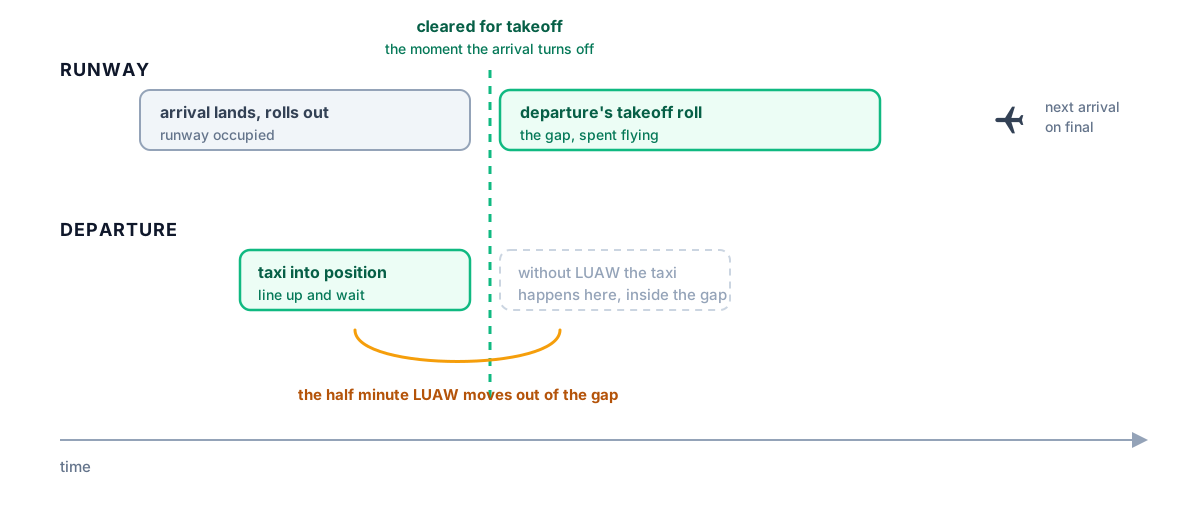
Line up and wait stages the next departure on the runway while the thing that prevents it from flying, usually an arrival still rolling out ahead, clears. Taxiing from the holding point onto the runway and lining up on the centerline takes a jet the better part of half a minute. Line up and wait moves that half minute out of the gap and into the time before it, while the arrival is still on the runway.
The intent of LUAW is to position aircraft for an imminent departure.
First state the runway number followed by the line up and wait clearance.
noteAn aircraft should not be in LUAW status for more than 90 seconds without additional instructions.
Delta Two Zero Two, runway two five right, line up and wait.
Line up and wait runway two five right, Delta Two Zero Two.
Two limits apply. The first is that the instruction is not a takeoff clearance, and pilots are trained to treat the difference as absolute. An aircraft in position waits there, engines spun up, until it hears the words Cleared for takeoffRunway two five right, wind two five zero at eight, cleared for takeoff.The runway is yours to fly from. Runway number first, then the wind, then the clearance, always in that order.Open in the glossary. The second is the ninety-second note, which limits how long the aircraft is exposed. An aircraft holding in position is parked on an active runway, and an arrival on final may be UnableUnable.I cannot comply with that instruction. Information, not defiance; it forces a new plan, fast.Open in the glossary to see it at night or in haze. The longer it sits there, the more likely you are to meet the situations chapter 13 covers. Put an aircraft in position only when its departure is imminent, and issue the takeoff clearance soon after.
The takeoff clearance
When the runway is yours to give, the manual fixes the words and their order.
When issuing a clearance for takeoff, first state the runway number followed by the takeoff clearance.
PhraseologyRUNWAY (number),CLEARED FOR TAKEOFF.
There is a practical reason for putting the runway first. The runway number is the one element a pilot can get wrong while doing everything else correctly. An aircraft lined up on the wrong parallel runway, cleared in perfect phraseology, will fly a perfect departure off the wrong runway. Leading with the number places it where the pilot's attention is highest, at the front of the transmission, and it gives the ReadbackThe pilot repeating a clearance or instruction back so the controller can verify it was received correctly.Open in the glossary a shape in which a wrong runway sounds wrong to both of you. You learned readback and HearbackThe controller's half of the loop: actually listening to the readback and catching the one that came back wrong.Open in the glossary in chapter 3. A takeoff clearance is where that loop matters most, because the time available to catch this mistake is measured in seconds.
When the gap is tight and you need the takeoff roll to start without a pause, one added word carries the urgency: cleared immediate takeoff. A pilot who accepts it starts rolling from the holding point without stopping in position. A pilot who cannot accept it says unable, and chapter 1 explained that word.
The wind in the clearance
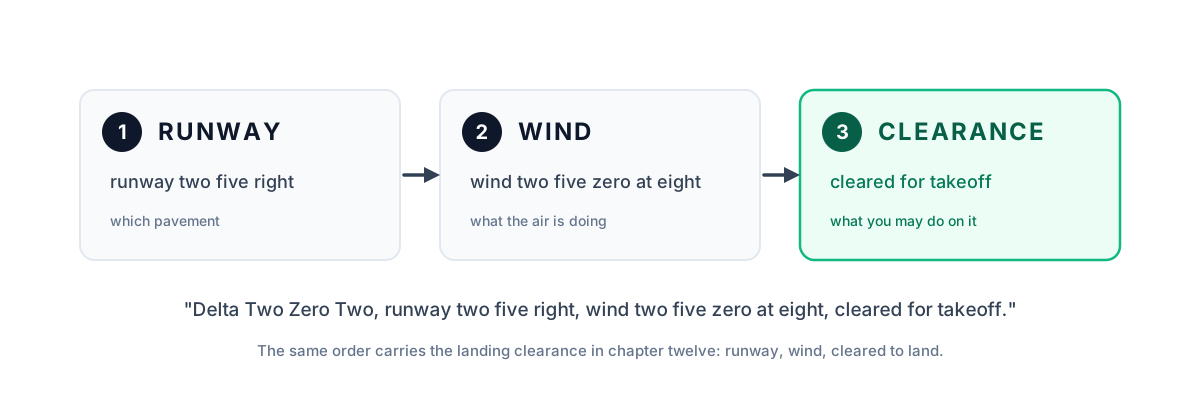
Between the runway number and the clearance comes the wind: the direction it blows from, then its speed, as in wind two five zero at eight. The wind is there for the pilot's decision. Every aircraft has crosswind and tailwind limits. The pilot cannot see your wind instruments, so the numbers you speak are what the pilot uses to decide whether this takeoff is within the limits of the aircraft. If you round the wind off or leave it out, you have made that decision for them.
Delta Two Zero Two, runway two five right, wind two five zero at eight, cleared for takeoff.
Cleared for takeoff runway two five right, Delta Two Zero Two.
That is the full form of the instruction this chapter is named for: runway, wind, clearance, in that order, with the readback closing the loop. Notice that the pilot reads back the clearance and the runway and does not repeat the wind. The wind is information, so the pilot does not read it back. Chapter 3 drew that line for the approach frequency, and it holds in the cab.
Cancelling a takeoff clearance
A takeoff clearance is a prediction that the gap will hold. Sometimes it does not. An arrival may close in faster than you judged, or something may enter the runway that should not be there. In either case the clearance is withdrawn.
Cancel a previously issued clearance for takeoff and inform the pilot of the reason if circumstances require. Once an aircraft has started takeoff roll, cancel the takeoff clearance only for the purpose of safety.
Before the takeoff roll starts, the cancellation is routine and costs a little time.
Delta Two Zero Two, hold position, cancel takeoff.
Holding position, Delta Two Zero Two.
Once the aircraft is rolling, the balance changes. A rejected takeoff at speed is itself a hazardous maneuver. It is hard on the brakes, the tires and the crew, so the rule reserves it for safety alone: say stop immediately, in a tone that leaves no doubt, and only when letting the takeoff continue is the greater danger. A rejected takeoff also does not give you the runway back. The aircraft is now HeavyUnited Four Heavy, Bayview Approach.A wake-turbulence class carried in the callsign of aircraft able to take off at 300,000 pounds or more, because the wake they leave behind is a hazard to whoever follows.Open in the glossary, slow and partway down the runway, the gap you were protecting is gone in any case, and your next few decisions are about getting the runway clear.
In the Sim
In ATC Simulator the departure loop runs as this chapter describes it. Ground is a computer voice that fills the holding point, and each departure calls you ready. The launch order of the departure queue is set by dragging strips on the strip board, as chapter 10 described. Line up and wait, the takeoff clearance and the cancellation are all spoken instructions that the parser recognizes in their standard forms. The order of the elements is graded. A clearance built runway first, wind second, clearance last earns a phraseology bonus. A bare cleared for takeoff is accepted leniently and still executes, the way a real pilot would still fly it.
The wind is spoken and never parsed, because it is live field data. Say the wind the cab shows you and the sim treats it as information. Cleared immediate takeoff is always accepted by the pilot, so the unable case is one real-world edge the sim does not present.
The sim diverges from the manual in two places. Timed departure separation, the seconds a tower counts between successive takeoffs, is not modelled. Runway occupancy stands in for it, and the whole rule is one aircraft on the runway at a time. A cancelled takeoff also ends the flight's time with you. After hold position or stop immediately, the aircraft taxis clear and returns to ground, so what the cancellation costs you is the lost gap and a strip that goes back to the end of your plan.