

Chapter one gave you the hard rule: keep aircraft a defined minimum distance apart, vertically or laterally, at all times. This chapter puts numbers on that rule. It then shows you how to use those numbers to build a sequence for the runway with the right spacing between arrivals, and how to share the same airspace between arrivals and departures.
Keeping them apart
An approach controller separates aircraft in one of two ways: three nautical miles measured across the ground, or one thousand feet measured vertically. Either one satisfies the rule on its own, and you never need both at the same time. Choosing which one to use for each pair of aircraft is the decision you make most often at the scope.
Separate aircraft by the following minima:
When less than 40 miles from the antenna- 3 miles.
Vertical separation has its own number, and it holds through every altitude an approach controller assigns.
Separate instrument flight rules (IFR) aircraft using the following minima between altitudes:
Up to and including FL 410- 1,000 feet.
There is a reason the rule gives you two numbers. Lateral separation costs room on the scope: a turn, or track miles spent holding a gap open. Vertical separation costs an altitude that nothing else can use while the aircraft holds it. You trade one for the other all the time. Two arrivals travelling in the same direction can be kept a thousand feet apart, and once three miles of lateral room has opened between them you can let the vertical gap close, or you can work it the other way round. Neither number is harder to satisfy than the other. The skill is in reading which one the traffic in front of you can give you at the moment.
One pairing needs more than the plain minimum. A large aircraft leaves a wake strong enough to upset anything that flies too close behind and just below its path. Spacing behind a HeavyUnited Four Heavy, Bayview Approach.A wake-turbulence class carried in the callsign of aircraft able to take off at 300,000 pounds or more, because the wake they leave behind is a hazard to whoever follows.Open in the glossary, which is one of the large widebodies, therefore grows past three miles, and how far it grows depends on both aircraft: a light aircraft trailing a heavy needs much more room than another heavy does. The full matrix of who needs how much behind whom is beyond this book for now. Know that the pairing matters, and that a heavy on your frequency changes the spacing for whoever follows it down the same path.
Building a line
Chapter one also named sequencing: turning a scatter of inbound aircraft into one orderly line for the runway, each aircraft in its place with the right spacing. This chapter teaches how to build that line.
Every aircraft in the sequence has a leading aircraft ahead of it and usually a following aircraft behind. The separation minimum sets the floor between the two. Sequencing is deciding how much room above that floor you want, and then holding it while both aircraft descend, slow down and turn onto the same final approach course.
Spacing between arrivals is measured in miles behind the aircraft ahead as it is now, and the number changes while you watch it. A following aircraft that is closing too fast takes a little out of the gap every second you leave it alone. One that lags too far back stretches the gap and wastes runway time that nobody else can use while it sits open. In both cases the fix is the same: read the trend on the scope and act on it early, while the gap is still comfortably above the minimum.
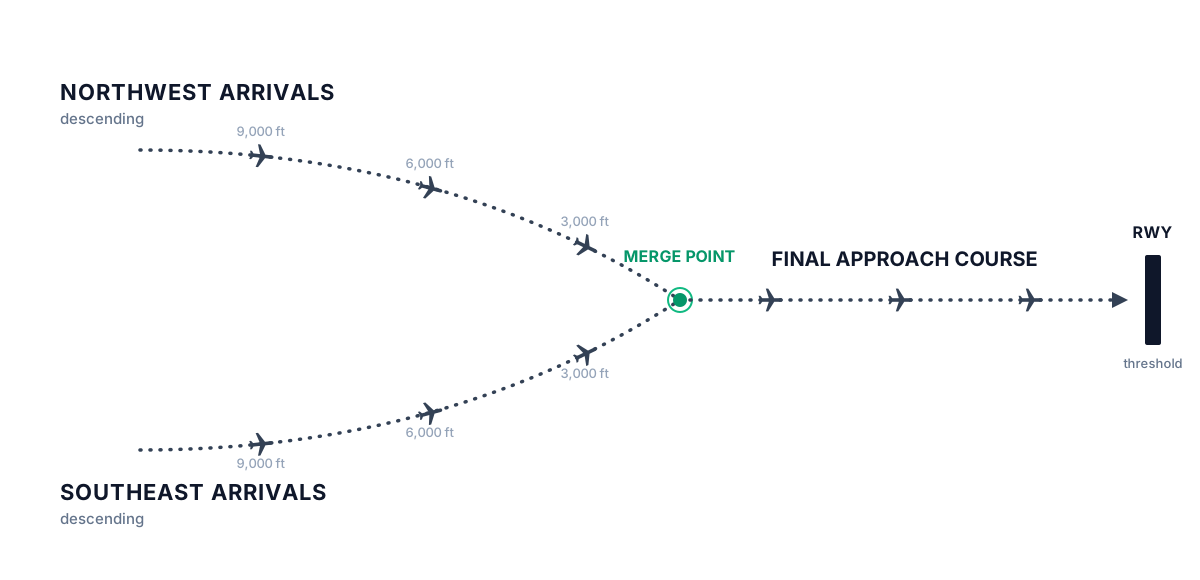
The point where the two streams meet is where a sequence becomes hard to undo. Every aircraft joins the final approach course in some order and with some spacing behind the aircraft ahead of it, and once it is established on that course its spacing is whatever you gave it. The rulebook states the task in one sentence.
Establish the sequence of arriving and departing aircraft by requiring them to adjust flight or ground operation, as necessary, to achieve proper spacing.
Speed before vectors
Two tools open or close the gap between two aircraft: speed and vectors. Use speed first.
Slowing the trailing aircraft, or letting the leading one keep its higher speed, changes the spacing between them without moving either one off its planned track. There is no extra turn, no extra miles flown, and nothing to rework for whoever you are sequencing behind them. A reduction of ten or twenty knots, held for a few minutes, opens or closes a gap by a mile or more while both aircraft stay on their own paths.
Southwest Eight Eight, reduce speed to two one zero.
Reduce speed to two one zero, Southwest Eight Eight.
Speed has a floor. Every aircraft has a speed it cannot go below without losing lift or running out of flap settings, and once two aircraft in the sequence are both near that floor, speed has nothing more to give. At that point you switch to vectors. Turn the trailing aircraft away from the course for some extra track miles, or cut the corner for the leading one; either move buys spacing that speed alone can no longer provide. Vectoring for spacing costs more than speed control does. It adds miles and minutes and gives someone a longer final, which is why it comes after speed in the order of tools.
Sharing the sky with departures
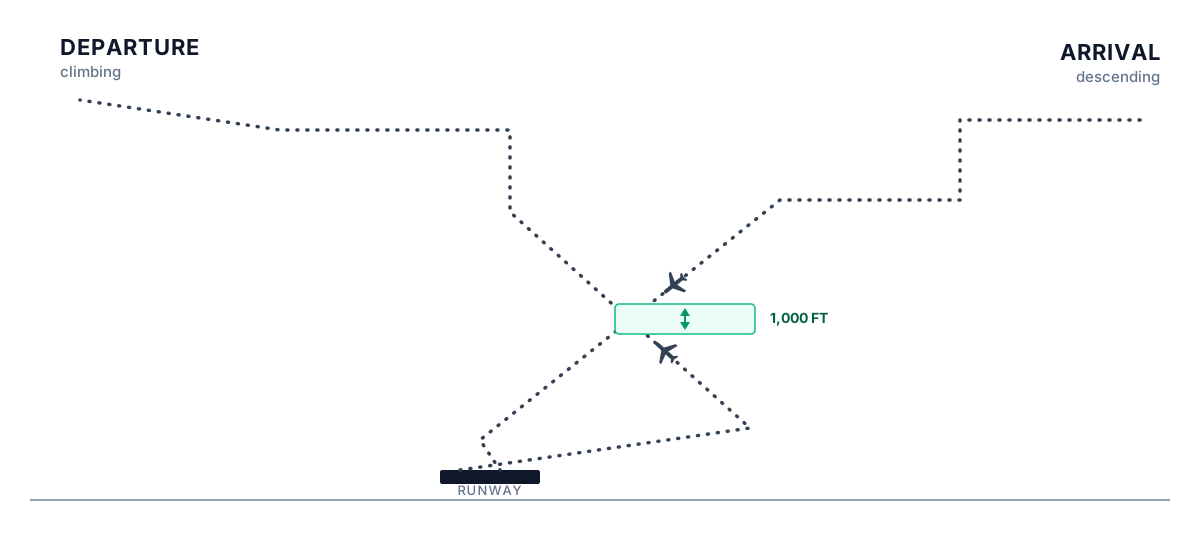
Arrivals are not the only aircraft in your sector. Every departure off two five right climbs into the same block of airspace that your arrival stream is descending through, and for the minutes it takes to climb clear of that stream the departure is your responsibility as well.
Altitude is the tool that makes the crossing routine. Hold the departure below the arrival stream with a low altitude restriction while traffic is still crossing above it. Once a thousand feet of separation exists some other way, usually because the arrival above has descended through or turned off toward final, let the departure continue its climb.
Speedbird Four Four, climb and maintain five thousand, expect higher in ten minutes.
Climb and maintain five thousand, expect higher in ten minutes, Speedbird Four Four.
Expect higher tells the pilot the restriction is temporary and gives them a figure to plan around. The ten minutes is an estimate. You can climb them sooner as soon as the traffic that justified the restriction has cleared out of the way. Crossing traffic reads the same on the scope whether it is a departure climbing through an arrival's altitude or two arrivals converging off different STARs. Hold vertical separation until the tracks diverge, or hold lateral separation until the altitudes converge, and never let both close at the same time.
Seeing a conflict early
Every conflict on your scope was visible before it became urgent. Two data blocks that are converging look the same for a full minute before their tracks cross: closing groundspeeds, headings that are not parallel, and altitudes that have not yet split. The picture shows you that a conflict is coming well before anything forces you to act on it.
You see it early by reading tracks. A snapshot of two aircraft ten miles apart tells you nothing about whether they are a problem. Extend the heading of each one forward as a line and the same two aircraft tell you a great deal: if those lines cross inside your separation minimum before either aircraft's altitude or course is due to change, you have work to do now, while the range between them is still comfortable.
The habit that catches conflicts early is a standing one. Recheck the picture every time you change an aircraft's altitude, speed or heading, because every change you make redraws every projected track that aircraft is part of. Do this check while you are still deciding whether to issue the instruction. A controller who checks only afterwards is always a step behind the traffic.
In the Sim
In ATC Simulator the separation minima from this chapter are what the game checks every second that two aircraft share the scope. When the geometry between two aircraft starts closing toward three miles and a thousand feet, the sim raises a short-term conflict alert in two tiers. A caution comes well before anything is wrong and is meant to catch your attention while a small instruction still fixes it. A harder alert is reserved for geometry that is about to breach the minimum.
A breach is scored in two different ways. A close call, where the minimum was threatened but never lost, is counted in the debrief and costs no points. A separation violation, where two aircraft closed inside three miles and a thousand feet of each other, costs a hundred points, and the third one in a shift ends it. Only the violation is treated as the failure it would be at a real facility.
The rest of the sequencing work in this chapter shows up in the score as well, as track miles. The sim measures how much farther each aircraft flew than the straight line from where it entered your airspace to where it left, allows a normal pattern's worth of extra distance, and charges a point for every mile beyond that, up to a cap per flight. Early speed control and an early read on a developing conflict keep that number low, and heavy vectoring to fix a problem caught late runs it up.
The endless ramp is the sim's open-ended session, where arrivals and departures keep coming for as long as you keep working them. There is no scripted end to the traffic, so a sequence built well the first time, with speed used early and departures threaded through the arrival stream without a scramble, keeps paying off shift after shift. A sequence built badly compounds into the kind of workload chapter one described, where a delay in one place spreads to everything behind it.