

Chapters one through eight gave you the rules. You know what separation is, how the radio works, how to vector an aircraft onto final, how to sequence a line of arrivals, and what to do on the day something goes wrong. Knowing the rules is a different thing from applying them under load. That ability comes from repetition, in traffic that grows by one aircraft and one complication at a time.
This chapter lays out the approach ladder, which you climb at the scope. It has five rungs: one arrival, two arrivals, many arrivals, arrivals mixed with departures, and a full working sector. Stay on each rung until the one below it takes no conscious thought, and climb in order. If you skip a rung, the same difficulty arrives later, on a rung where you have less attention to spare for it. The tower seat has a ladder of its own, and chapter thirteen ends with it.
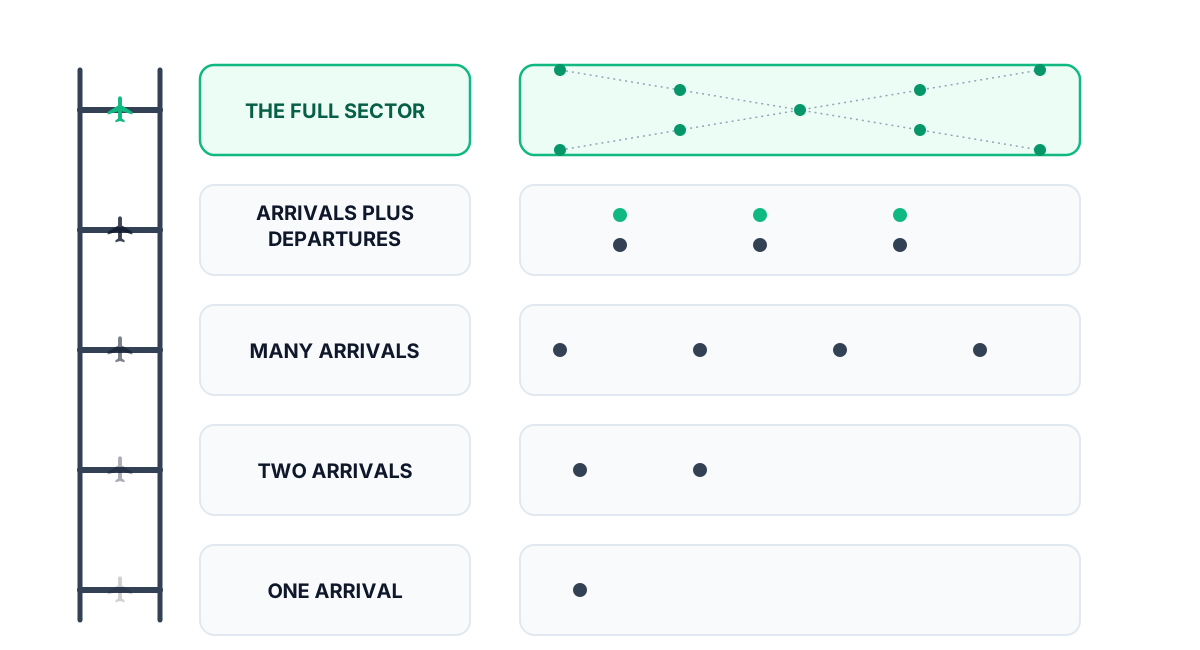
One arrival
Your first shift at the scope should have one aircraft on it. Work that aircraft through the five things you do to every arrival: identify it, descend it, vector it, clear it for the approach, and hand it to the tower. Chapter four described the anatomy of an arrival, and chapters five and six covered the vectoring and the approach clearance that make up the middle of the sequence. On this rung you run the whole sequence from start to finish on a single aircraft, and you repeat it until you no longer have to recall what the next step is.
Speedbird Four One Two, Bayview Approach, descend and maintain four thousand, fly heading two seven zero.
Descend and maintain four thousand, heading two seven zero, Speedbird Four One Two.
That exchange is one of the five steps. Working a single aircraft lets you follow a whole exchange from your instruction to the ReadbackThe pilot repeating a clearance or instruction back so the controller can verify it was received correctly.Open in the glossary with nothing else on the frequency. Pay attention to the pauses between steps. A long pause is you deciding what comes next, and it gets shorter as the five separate decisions turn into one habit.
Two arrivals
When a second aircraft checks in, the first question to settle is which aircraft is number one. Chapter seven gave you the spacing minima. Here you use them to make that decision quickly, and the usual answer is the aircraft that is closer to the runway or established on the approach first. Once you have made the decision, keep to it.
- Decide who is number one as soon as the second aircraft checks in, and revisit the decision only if something changes underneath it.
- Speed controls spacing as much as vectors do. A faster aircraft behind a slower one closes the gap without a single turn.
- The second aircraft is waiting on your plan, so work out the sequence before you speak to either one.
Working two aircraft also teaches you to split your attention between the conversation you are having and the one you are about to have. That split is the core of the job from this point on, and it starts small: while the first aircraft is reading back, you are already forming the plan for the second.
Many arrivals
With four or five arrivals in the same piece of sky, spacing and speed become a system you run continuously. Every speed assignment moves every gap behind it, and a new arrival checking in at the back of the line can change a sequencing decision you have already made for the aircraft ahead. The rules are the ones from chapter five on speed application and chapter seven on spacing minima, the same rules you used with two aircraft. The difference is that you apply them to five aircraft, over and over, for the whole time they are in your sector.
The scan is what makes that possible. Sweep the scope in the same order every time, checking position and altitude on every aircraft, before you decide anything. A fixed scan order is what keeps a closing gap from taking you by surprise. If you only look at whatever seems urgent, you miss the gaps that are closing elsewhere on the scope, because the aircraft that draws your eye is often not the one that matters most.
The picture keeps moving while you work. Traffic does not pause while you think, so the plan in your head is always a little behind the aircraft. Update the plan a piece at a time, as part of each scan, so that you never have to rebuild it from nothing when someone calls.
Arrivals plus departures
Now add Bayview Tower's departures off two five right to the same airspace. Your arrival flow is no longer the only traffic on the frequency. A departure climbing out crosses the path of arrivals descending toward the same runway, and altitude is the tool that keeps them apart without changing anyone's heading. Hold the departure below the arrival stream, or the arrival above the departure, until their paths have diverged enough that vertical separation is no longer the only thing keeping them apart.
Protecting the climb-out means thinking one step ahead of the handoff. Tower releases a departure expecting a clear path through your airspace. If an arrival is going to cross that path, assign the altitude that keeps them apart before the departure leaves the ground. If you wait until the two data blocks are converging on your scope, the altitude has to be found in a hurry.
Two aircraft on paths that diverge can share airspace that two aircraft on the same path cannot. Most of the practice on this rung is learning to tell the two cases apart quickly and correctly.
The full sector
The full sector is everything at once: arrivals in a sequence, departures climbing through it, a runway that can change without warning, and now and then a problem of the kind chapter eight prepared you for. There is no new rule on this rung. All of the earlier material now runs at the same time, on the same frequency, and your voice is the only one sorting it out.
Real controllers earn a working position through on-the-job training. The milestone at the end of it is called checking out: a supervisor watches the trainee run live traffic without help and signs off that they can hold the position alone. Nobody signs you off here. The goal on this rung is the same in substance. You run the full sector until the four rungs below it cost you no conscious thought, so that all of your attention goes to the traffic in front of you.
In the Sim
ATC Simulator builds this ladder into eleven guided approach lessons, and the cab's ladder in chapter thirteen into five more. Each one is a short playable shift with a mentor voice that talks you through the steps, and hints are available if a step does not work the first time. The lessons stay unlocked in any order, and the game remembers which ones you have finished, so you can return to the one that gave you trouble at no cost. The early lessons sit on the first two rungs: reading the scope and issuing a first vector to a single aircraft. The middle of the course adds sequencing and a runway change that makes you replan a full arrival stream during the shift. The last lessons add a departure and then an emergency. Every lesson is scored the same way a live shift is, on the separation you kept and the sequence you built, and you can repeat any lesson as many times as you need.
The endless ramp is the graduation exercise. It is a shift with no shift length set. Traffic keeps arriving for as long as you keep working it, at whichever difficulty tier you have chosen, and there is no scripted ending to tell you that you have passed. You find out the same way a trainee on the job does: the sector keeps running and you are still ahead of it. All of this is the approach seat. The tower shift is scored on its own terms, and chapter thirteen closes with the cab's version of this ladder.