

Every chapter so far has taken the runway in use for granted. Arrivals were set up for two five right, departures taxied to two five right, and the wind on the recording was a number you read to a pilot with the landing clearance. This chapter is about the day that number moves. A front comes through, the wind swings ninety degrees and doubles, and the runway you have been working all afternoon is outside its limits. The tower decides that, puts it on the recording, and turns every aircraft on the field and on final round to the other end.
The work divides into three parts: reading the wind, knowing the rule that picks a runway from it, and running the change once you have called it.
Reading the wind
A surface wind is reported as a direction and a speed: three three zero at two four means the wind is blowing from three three zero degrees magnetic at twenty-four knots. Gusts are added when they matter, two five zero at eight gusting one eight. A wind below three knots is reported as calm, and the manual says so in as many words. Direction is where the wind comes from, never where it is going, and it is magnetic, like a runway number. That is the whole point of the convention: runway three three points to three three zero degrees, so a wind from three three zero blows straight down it.
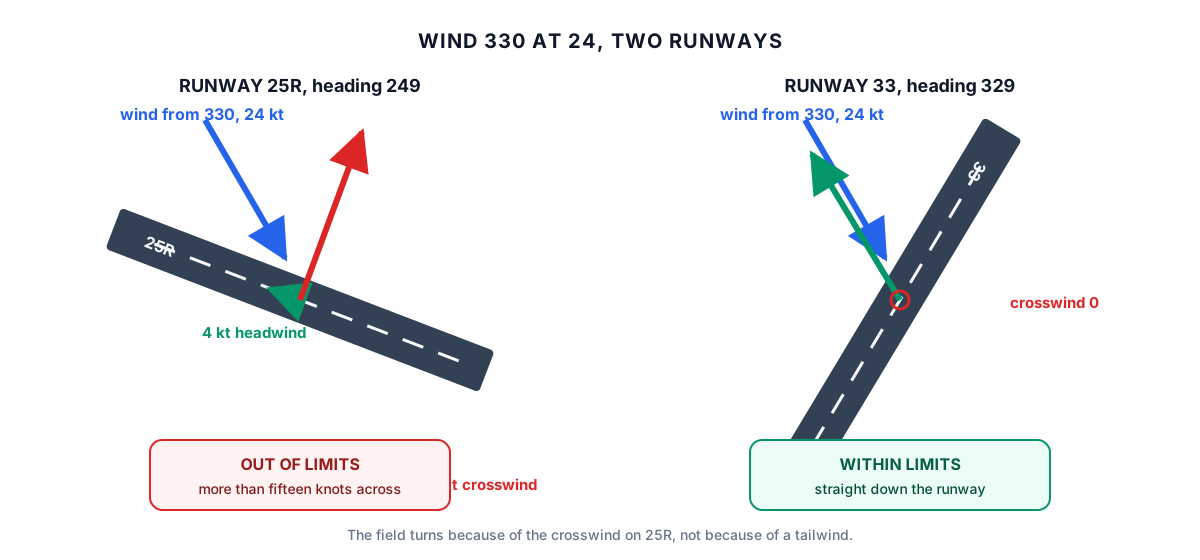
What a runway feels is the wind split into two components. The headwind component is the part blowing along the runway toward the aircraft; a NegativeNegative.No.Open in the glossary headwind is a tailwind. The crosswind component is the part blowing across it. You do not need trigonometry at the scope. Take the angle between the wind and the runway heading. Within thirty degrees, nearly all of the wind is headwind and less than half of it is across. At sixty degrees, half of it is headwind and most of it is across. At ninety degrees, none of it is headwind and all of it is across. Two five zero at eight on runway two five right, heading two four nine, is eight knots of headwind and nothing across. Three three zero at two four on the same runway is eighty-one degrees off: four knots of headwind and twenty-four across. On runway three three the same wind is twenty-four knots straight down the runway.
The recording
The information broadcast is the field's memory of the weather. It carries the wind, the visibility, the ceiling, the altimeter setting, the runways in use and any remarks, under a letter that advances with each new recording. Pilots listen to it before they call you and report the letter on first contact, and that letter is how you know they have the picture you have. The manual's rule for when a new recording is made is short, and a runway change is on the list:
Maintain an ATIS message that reflects the most current arrival and departure information.
Make a new recording when any of the following occur:
When there is a change in any other pertinent data, such as runway change, instrument approach in use, new or canceled NOTAMs/PIREPs update, etc.
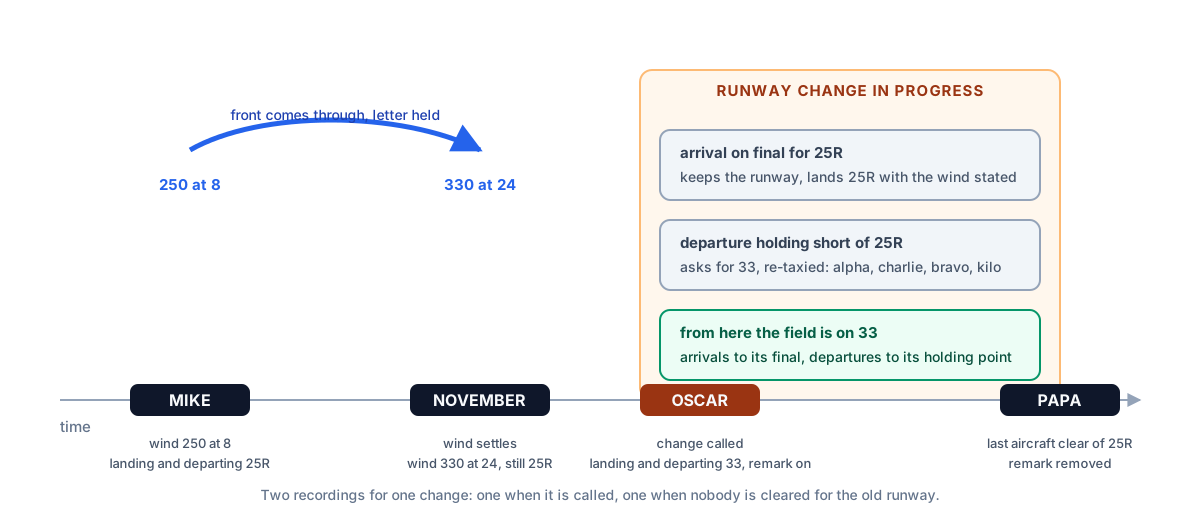
A new letter costs every aircraft on frequency a call. The manual has the tower announce it, attention all aircraft, information November current, and a pilot who checks in with the old letter is asked to confirm the new one. So the letter is not advanced for every gust. The recording holds while the wind is still moving through a front, and a new one is cut when the wind has settled and the observation means something. Between recordings, a change that matters to an aircraft in your hands is issued to that aircraft directly, which is why the landing clearance carries the wind.
Which runway
The runway in use is a decision, made by the tower and held until the wind takes it away. Chapter ten quoted the selection rule: use the runway most nearly aligned with the wind when it is five knots or more, and the calm-wind runway when it is less. A facility with a runway use program lists its preferred runways in order, and a preferred runway stays in use as long as the wind allows it, because every change costs time, taxi distance and a recording. Bayview's order is two five right, then zero seven left, then three three, then one five.
The tower's limits are stricter than a pilot's. A runway stays in use until the wind puts more than five knots on its tail or more than fifteen knots across it, the crosswind limit of the lightest aircraft the field handles. Past either figure, the tower looks for the first runway on the list that is within limits. A change only goes ahead when the other end gains at least five knots of headwind over the one in use; a wind that has drifted a few degrees is no reason to turn a field around. In the example above, two five right is out of limits on crosswind while it still has four knots of headwind, and three three gains twenty, so the change goes ahead.
When the tailwind component is not zero, the wind goes into every runway clearance:
When authorizing use of runways and a tailwind component exists, always state both wind direction and velocity.
You already give the wind with every landing and takeoff clearance. This rule is the reason it is there.
Calling the change
A runway change in a tower with the ground combined is a sequence, and the order matters. First the decision: the wind is outside the limits of the runway in use and the other end is worth it. Second the recording: a new letter, the new runway, and the remark runway change in progress, which stays on the broadcast while any aircraft is still cleared for the old runway. Third the traffic, which sorts itself into three groups.
An arrival already cleared for an approach or for landing on the old runway keeps it. She has been set up for that runway for ten miles, and turning her onto a new final at four miles is worse than one more landing with a crosswind she can take. The tower lands her, with the wind stated, and she is the last aircraft on the old runway.
A departure in position or rolling on the old runway is yours to finish. A departure anywhere behind the hold line is not: at the stand, on the taxiways or holding short, she needs the new runway, and she says so once.
Bayview Tower, Delta One Two Zero, holding short of runway two five right, we will need runway three three.
Delta One Two Zero, runway three three, taxi via alpha, charlie, bravo, kilo.
Runway three three, taxi via alpha, charlie, bravo, kilo, Delta One Two Zero.
The taxi clearance is the one chapter fourteen taught, runway first and then the route, and the route starts from where the aircraft is now. At Bayview the way from the two five right Holding pointThe marked position at the runway entrance where a departure waits for its clearance. Crossing the marking without one is a runway incursion.Open in the glossary to three three runs back along Alpha, Charlie and Bravo through the ramp and out along Kilo. A ground controller on a separate frequency does the same re-taxi for you and you hear only the ReadbackThe pilot repeating a clearance or instruction back so the controller can verify it was received correctly.Open in the glossary.
American Two One Five, runway two five right, wind three three zero at two four, cleared to land.
Runway two five right, wind three three zero at two four, cleared to land, American Two One Five.
Once the last arrival is clear of the old runway and every departure has been re-taxied, nobody is cleared for it any more. The remark comes off with the next recording, and from then on the field is simply on three three: arrivals are delivered to its final by approach, departures taxi to its holding point, and the change is over. Two recordings for one change is the usual count, one when it is called and one when it is complete.
The pilot's limits
The tower's limits protect the field. Each pilot has limits of the aircraft as well, and they are wider. An airliner accepts about ten knots of tailwind and thirty across; a light single accepts fifteen across and not much more. A clearance onto a runway outside those limits is refused, and the refusal names the runway the pilot wants:
Cessna Four Seven Two Bravo Kilo, runway two five right, wind three three zero at two four, cleared for takeoff.
Unable runway two five right, request runway three three, Cessna Four Seven Two Bravo Kilo.
The refusal tells you one of two things: the field should already have turned, or this one aircraft cannot use the end that suits everybody else. Give that aircraft the runway it asked for, re-taxi it, and look again at the wind and at the rest of your traffic. The call is rare at a tower that changes runways when the wind asks for it, and when the old runway is kept too long the lightest aircraft on the field is the first to make it.
When the weather comes down
Wind is the part of the weather that changes the runway. Visibility and ceiling change what the runway can be used for. Below three miles of visibility or a thousand feet of ceiling the field is no longer in visual conditions: there are no visual approaches, and the lightest aircraft, the ones flown by visual reference, stay on the ground. Every arrival flies the instrument approach to its runway. Below half a mile of visibility or a two-hundred-foot ceiling the field is below the minimums of the ILS itself, and an arrival that reaches the decision height without seeing the runway goes around. Chapter eight covered the missed approach as a surprise; in fog it is the expected outcome, and approach holds the aircraft for a while in case the weather lifts and then sends it to its alternate. The tower's own observation matters here too: when the visibility from the cab is less than four miles, the tower's figure is compared with the weather station's and the lower of the two is used.
None of this changes the runway. A fog bank on a calm morning leaves the field on its preferred runway with the light traffic on the ground, and a front on a clear afternoon turns the field around with every aircraft still flying. The recording carries both kinds of change.
In the Sim
In ATC Simulator every shift draws its own weather, and the ready room's Weather card lets you bias the draw toward a clear day, a marginal one or a low one, or leave it to chance. The wind, visibility, ceiling and altimeter are on the recording and on the airport screen, where the wind line is updated as it changes, and fronts and fog move the weather during the shift. Pilots check in with the current letter, and a new one is cut when the wind has settled after a front, when the visibility or ceiling changes materially, and when the runway changes.
The runway in use follows the rule in this chapter: more than five knots on the tail or fifteen across takes a runway out of limits, the airport's list decides the replacement, and the other end has to gain five knots. On an approach shift the tower next door calls the change on its own, as the tenth lesson has always shown, and you re-clear your arrivals for the new runway. On a tower shift nothing turns until you call it. The airport screen says that the wind favours the other runway and offers the change only while the wind asks for it, so the field is never turned against its own limits. The remark runway change in progress stays on the recording while anyone is still cleared for an old runway, for a quarter of an hour at most, and one more letter follows when it is complete. Arrivals keep the runway they were cleared for; the unseen ground re-taxis departures to the new runway and you hear the readbacks; with the ground combined, each departure that needs the new runway says so once, and your taxi clearance to a runway in use re-files it. Bayview turns both of its runways end for end; San Francisco moves its departures between the ones and the two eights while arrivals stay on the two eights.
Pilots refuse a runway outside their own limits in words, ten knots of tailwind for anyone and a crosswind of fifteen knots for a light single and thirty for the rest, and ask for the other end. Below visual conditions there are no visual approaches and no light singles; below minimums arrivals Go aroundGo around, I say again, go around.Break off the approach, climb, and fly the missed approach. The arrival's escape when the runway stops resolving.Open in the glossary at decision height, hold for a few minutes, and divert with a call to the centre. The sim diverges from a working cab in the arithmetic it does for you: the components are computed, not estimated, so a wind at seventy-five degrees to the runway is judged on its exact crosswind figure. The lesson for this chapter is the twentieth guided shift: a front comes through with a departure holding short and an arrival on final, you call the change from the airport screen, re-taxi the departure to three three, land the arrival on the old runway with the wind stated, and launch the first departure off the new end.