

Chapters eleven and twelve taught you to judge gaps on the runway. This chapter covers what to do when that judgement is wrong. Anticipating separation, Line up and waitRunway two five right, line up and wait.Taxi onto the runway and stop on the centerline, staged for an imminent departure. It is not a takeoff clearance, and pilots treat the difference as absolute.Open in the glossary and the early landing clearance all depend on the runway picture developing the way you read it, and a tower controller relies on that reading dozens of times an hour. Most of the time it holds. When it does not, you need the recovery instructions in this chapter without stopping to think.
Nothing in this chapter is improvised. Each escape from a closing gap is a published maneuver with fixed words. Pilots are trained for every one of them before they ever talk to you, and the system is designed on the assumption that gaps will sometimes close. Ordering the escape is routine work, and the time to order it is as soon as you see the need.
Misjudging the gap
A misjudged gap shows itself before it becomes dangerous, and it shows itself visually. The arrival that has landed is still on the runway after the point you allowed for. The takeoff roll starts a beat later than you expected. The aircraft on final is closing faster than your plan assumed. The scan from chapter ten catches these signs. If you look at the runway before and after every transmission, you see the gap closing while the arrival still has miles of final left, which is time you no longer have if you only look up when something feels wrong.
If you catch a closing gap early, it costs little. You hold the next departure at Alpha instead of lining it up, or you let the landing clearance window from chapter twelve run a little longer before you clear the arrival. Once the gap has closed too far for either of those, you have two instructions left, one for the arrival and one for the departure. The rest of this chapter covers those two instructions, the fault they both exist to contain, and the conditions in which the view from the cab is no longer enough.
Sending one around
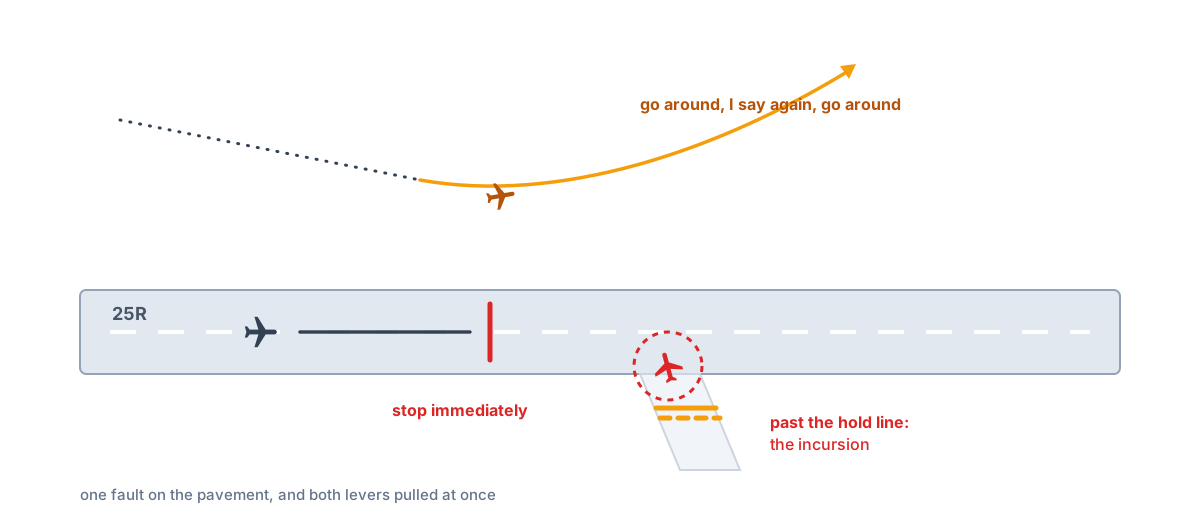
The instruction for the arrival is the go-around. Use the full form, with the phrase repeated, because it cannot be mistaken for anything else on a busy frequency:
American Two One Five, go around, I say again, go around.
Going around, American Two One Five.
The aircraft breaks off the approach, climbs straight ahead on the published missed approach procedure you met in chapter eight, and returns to approach control to be fed into the line again. This costs the flight about ten minutes and a large amount of fuel, and the cost is accepted because it protects something worth more. Order the go-around as soon as you can no longer confirm that the runway will be clear in time. Do not spend those seconds hoping the aircraft on the runway will reach its exit sooner than it can.
The rulebook puts a limit on this instruction, quoted here in full because it protects the pilot from you:
Do not withhold a landing clearance indefinitely even though it appears a violation of Title 14 of the Code of Federal Regulations has been committed. The apparent violation might be the result of an emergency situation. In any event, assist the pilot to the extent possible.
You cannot keep answering an arrival with not yet. Even an aircraft that appears to have broken a rule on its way to your runway is given a landing clearance and your help. Whatever it did wrong may be the result of an emergency you cannot see from the cab, and the runway is the safest place for the crew to sort it out.
Stopping one on the roll
You already hold the instruction for the departure. Chapter eleven taught the cancellation of a takeoff clearance, and before the takeoff roll begins it is a routine call. Once the aircraft is rolling, the words change, and so does the seriousness of what you are asking:
Delta Two Zero Two, stop immediately.
Stopping, Delta Two Zero Two.
"Stop stop stop" is the same instruction, and it is the one you will hear on a real frequency. It is not written for the takeoff roll alone. Say it to an aircraft in the landing rollout and it brakes to a halt on the runway the same way; say it to one taxiing, crossing or leaving the runway and it stops where it stands, on the pavement if that is where it was, and waits there until you release it. "Continue taxiing" releases a stopped taxi; a crossing, line-up, takeoff or turn-off clearance releases it just as well. Whatever you stop, you own until you move it.
A rejected takeoff at speed is hard on the brakes, the tires and the crew, and it converts a departure problem into a runway problem: the aircraft ends up stopped partway down the pavement, and the arrival you were protecting may need a go-around anyway. The manual therefore reserves the rolling stop for safety. Use it when something is on the runway ahead of the departure, or when the departure and an arrival are about to meet. Do not use it to repair a gap that is merely embarrassing. Of the two instructions, the go-around is almost always the cheaper one, because a climbing aircraft can be re-sequenced anywhere in the sky, while a stopped aircraft has only your runway.
The runway incursion
Both instructions exist to contain one fault: something on the runway that should not be there. It may be an aircraft that taxied past its hold line, a vehicle that crossed without your permission, or an arrival cleared onto a runway that a departure is still using. The manual leaves no room on this point:
Ensure that the runway to be used is free of all known ground vehicles, equipment, and personnel before a departing aircraft starts takeoff or a landing aircraft crosses the runway threshold.
The runway is to be free of everything known to be there, checked with your own eyes, before every use. When the check fails, you use whichever instruction fits. The arrival goes around, the departure stops or holds, and anything that has not started moving stays where it is:
United Eight Eight, hold short of runway two five right, vehicle on the runway.
Holding short runway two five right, United Eight Eight.
A Runway incursionAnything on protected runway surface that should not be there: an aircraft past its hold line, a vehicle without approval. The accident category towers exist to prevent.Open in the glossary is the kind of accident towers exist to prevent, and the worst disasters in the record belong to this category. The defenses against a runway incursion are everything this part of the book has taught: one controller owns the pavement, nothing enters it without that controller's word, the runway is scanned before every clearance, and every ReadbackThe pilot repeating a clearance or instruction back so the controller can verify it was received correctly.Open in the glossary is listened to all the way through. Each of these is a habit, and when one of them fails the others are still in place.
When the window stops working
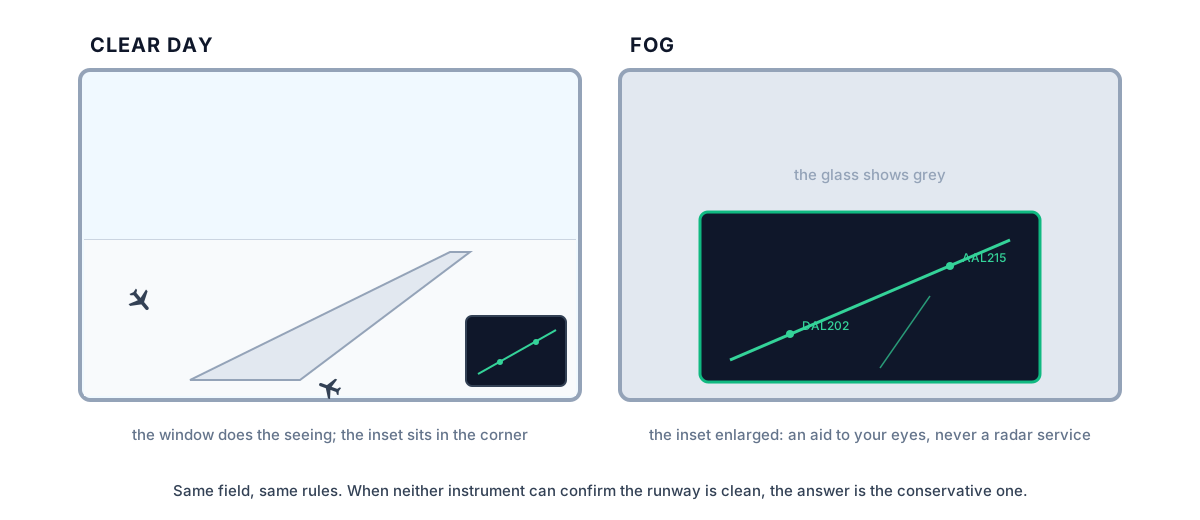
The view out of the cab windows is the tower's primary instrument, and it fails in predictable conditions: fog, rain, dusk, or a runway end two miles from the glass. The fallback for those conditions is a radar picture of the airport surface, and the manual is specific about what such a display may be used for:
Uncertified tower display workstations must be used only as an aid to assist controllers in visually locating aircraft or in determining their spatial relationship to known geographical points.
noteIn addition, local controllers at nonapproach control towers must devote the majority of their time to visually scanning the runways and local area; an assurance of continued positive radar identification could place distracting and operationally inefficient requirements upon the local controller.
The display is only an aid. It shows you where the aircraft are so that you know where to look. It does not become a radar service, and it does not relieve you of the scan. On a clear day you will hardly glance at it. In fog it may be most of the picture you have. The discipline is to remember which of those two days you are working in. The display supplements the window, and when neither the window nor the display can confirm that the runway is clear, you give the conservative answer to every request.
Working the tower shift
The cab has a training ladder like the one on the approach scope, and it is climbed the same way, one habit at a time. In ATC Simulator each rung is a guided lesson, described at the end of this chapter. Start with single events: one arrival worked from check-in to the VacateLeave the runway. An aircraft is clear of the runway once all of it is past the holding position marking, and the pilot is the one who determines it.Open in the glossary call, then one departure from the ready call to the handoff, with nothing else moving. Next run both streams together at an easy rate, and let the strip board hold the plan while your eyes stay on the runway. Then tighten the gaps until line up and wait and anticipated separation stop feeling like decisions and become routine. Last, add the bad day on purpose: a gap you misjudged, a go-around you order early, a stop you call because the alternative is worse. As on the approach ladder, skipping a rung moves the struggle to a later and more expensive stage.
When you have climbed it, the two halves of this book join up. The approach seat builds the line to the runway and the cab uses it, and the handoff between them is the same one you made from the other side in chapter six.
In the Sim
In ATC Simulator every recovery in this chapter is available in the tower shift. The go-around, the cancellation and the rolling stop are all spoken instructions in their standard forms. A stopped aeroplane stays where it stopped, on your runway, until you tell it which taxiway to leave by and send it to ground; it will call you again every half minute while it waits, and it will back-taxi to a turn-off behind it if that is the one you name. The runway incursion is modelled too. If you clear an aircraft onto an occupied runway, the alert fires, the score takes the same hundred-point penalty a separation violation costs, and the event counts against the same three-strike counter that a mid-air conflict does. The scoring is fair in the other direction as well. A go-around you could not have prevented, by an arrival you were never in a position to clear, is scored as the aircraft's own escape and does not count against you. The ground radar display from this chapter is the cab's corner inset. When the visibility drops below three miles it expands on its own, since the window is no longer the better instrument, unless you have already sized it yourself during that shift, in which case your choice stands.
The ladder in the previous section is five guided lessons in the ready room, each a short playable shift with a mentor voice: one arrival worked to the vacate call, one departure worked to the handoff, both streams on one runway, the tighter gap with line up and wait under an arrival, and the bad day with a go-around you order and a takeoff you cancel. Each of the four tower chapters opens its own lesson from the page. When the course is done, the beginner difficulty keeps the traffic rate gentle for your first shifts.
The sim differs from a working cab in two ways. There is no vehicle or pedestrian traffic, so every incursion you meet is one aircraft against another, and the Hold shortStop before the runway's holding position marking and do not enter. Hold short instructions must be read back.Open in the glossary call for a vehicle on the runway is phraseology from the working tower that you will not need in the game yet. At the second field, where departures roll on runways that cross the landing pair, the crossing conflict itself is not modelled and occupancy is tracked per runway.