

Snow on the runway and braking action
Chapter 15 covered how wind and visibility move the active runway and update the ATIS. When the field temperature drops to freezing or below, precipitation stops draining off the runway and begins accumulating on the pavement. Snow, slush and ice form a lubricating layer between an aircraft's tyres and the concrete, reducing the friction that crews rely on to decelerate and steer on the ground.
On landing, wheel brakes do most of the work of slowing the aircraft after touchdown, assisted by spoilers and reverse thrust. On a snowy or icy runway, the anti-skid system releases brake pressure repeatedly to prevent locked wheels, lengthening the landing roll and reducing crosswind directional control. For the tower, every arrival occupies the runway longer than it would on dry pavement, so the final approach spacing that worked in clear weather can leave an arrival still rolling when the next flight crosses the threshold.
Departures depend on surface friction as well. Up to decision speed, a crew must be able to reject the takeoff and stop on the remaining runway while keeping the aircraft on the centreline in a crosswind, and slush or snow on the pavement both slows acceleration and lengthens the stopping distance if the roll is aborted.
Braking action, reported on a six-step scale from best to worst (good, good to medium, medium, medium to poor, poor, and nil), is what pilots use to judge grip; snow depth does not tell them how the tyres will hold because cold powder and wet slush behave very differently under load. At medium and poor, stopping distances increase markedly and steering degrades; at nil, braking is negligible or non-existent, and flight crews will not take off or land on that surface.
Reporting the surface to pilots
The airport operator is responsible for inspecting the landing area, measuring contamination, and reporting surface conditions to the tower. Your role in the cab is to take the reports provided by airport management and by pilots, place them on the ATIS, and pass updates on the frequency in time for crews to use them before starting an approach or taking the runway.
Issue airport condition information necessary for an aircraft's safe operation in time for it to be useful to the pilot. Include the following, as appropriate:
Braking conditions caused by ice, snow, slush, or water. Snowdrifts or piles of snow on or along the edges of the area and the extent of any plowed area.
Along with braking conditions, snowdrifts along the runway edges and how much of the width has been ploughed, timely airport condition advisories cover construction work near the movement area, rough pavement, parked aircraft on the movement area, and irregular airport lighting. When the airport operator inspects a winter runway, it grades each third of the pavement (touchdown, midpoint and rollout) using Runway Condition Codes (RwyCC) from six down to zero. Those codes go out on the ATIS with the runway number, the three segment codes and the report time, and any update is issued verbally to all aircraft until the ATIS recording can be changed. Where no RwyCC is available, you issue only factual descriptions of the accumulation as reported.
If you observe or are informed of any condition which affects the safe use of a landing area:
Relay the information to the airport manager/military operations office concerned. Copy verbatim any information received and record the name of the person submitting it.
Furnish RwyCC, as received from the Airport Operator, to aircraft via the ATIS. Use the runway number, followed by the RwyCC, for each of the three runway segments, and include the time of the report.
When an update to the RwyCC is provided, verbally issue to all aircraft until the ATIS broadcast can be updated.
Between airport inspections, flight crews report how the surface feels during rollout using the standard braking action terms. When pilot reports of medium, poor or nil arrive, or when weather conditions are causing the surface to deteriorate rapidly, the ATIS broadcasts that braking action advisories are in effect. While they are, you pass the latest braking action report for the active runway to every arriving and departing aircraft early enough to help, include reports from HeavyUnited Four Heavy, Bayview Approach.A wake-turbulence class carried in the callsign of aircraft able to take off at 300,000 pounds or more, because the wake they leave behind is a hazard to whoever follows.Open in the glossary or super aircraft when working another heavy or super, tell crews when no report has been received ("no braking action reports received for runway two five right"), notify the airport operator of any report of good to medium or worse, and ask pilots for further braking action reports.
When runway braking action reports are received from pilots which include the terms "medium," "poor,"or "nil," or whenever weather conditions are conducive to deteriorating or rapidly changing runway conditions, include on the ATIS broadcast the statement "Braking Action Advisories are in effect."
During the time Braking Action Advisories are in effect, take the following action: Issue the latest braking action report for the runway in use to each arriving and departing aircraft early enough to be of benefit to the pilot. When possible, include reports from super or heavy aircraft when the arriving or departing aircraft is a super orheavy. If no report has been received for the runway of intended use, issue an advisory to that effect.
Advise the Airport Operator that runway braking action reports of "good to medium," "medium," "medium to poor," "poor," or "nil" have been received.
Solicit PIREPs of runway braking action.
United Four Four Seven, Bayview Tower, runway two five right, cleared to land, wind two six zero at eight, braking action advisories are in effect, braking action reported medium by a Boeing seven three seven, say braking action on turnoff.
Cleared to land runway two five right, will report braking action, United Four Four Seven.
Bayview Tower, United Four Four Seven is clear of two five right at foxtrot, braking action poor in the rollout.
United Four Four Seven, roger, thank you, contact Bayview Ground.
Closing the runway for the ploughs
Legally, only airport management can close a runway. When a controller learns of an unsafe condition on the landing area, the controller relays it to airport management, copies the report verbatim with the reporter's name, and confirms anything that comes from a source outside authorised airport or FAA staff. In a snowstorm, airport operations monitors the accumulation and calls the tower when the ploughs and brooms need the runway closed to clear it.
Snow clearing takes place with the runway closed to aircraft while a team of ploughs and sweepers works down the pavement together. Vehicles on the movement area move only with your approval and enter a runway only on the tower's explicit authorisation, following the same surface rules covered in chapter 14. When the snow team lead asks for the active runway, you coordinate with approach or use a gap on final so no arrival is left committed to the threshold, hold departures short at the Holding pointThe marked position at the runway entrance where a departure waits for its clearance. Crossing the marking without one is a runway incursion.Open in the glossary, and wait until the last aircraft has exited the runway. Once the pavement is clear of traffic, you take the runway out of use at the airport operator's request and clear the ploughs onto the surface.
Bayview Tower, Snow One, runway two five right braking action poor, request runway two five right closed for snow removal.
Snow One, Bayview Tower, stand by, one arrival on short final.
Standing by, Snow One.
Snow One, runway two five right closed for snow removal, proceed.
Runway two five right closed for snow removal, proceeding onto two five right, Snow One.
A closed runway is off limits to every aircraft clearance: no landing, takeoff, Line up and waitRunway two five right, line up and wait.Taxi onto the runway and stop on the centerline, staged for an imminent departure. It is not a takeoff clearance, and pilots treat the difference as absolute.Open in the glossary, or touch-and-go may be issued for it, and the closure goes into the ATIS remarks. Any arrival still inbound to a closed runway must be sent around. Once the ploughs finish their pass and pull past the hold lines, the team lead reports snow removal complete and all vehicles off the runway. You visually scan the surface to confirm every truck is clear, reopen the runway, update the ATIS, and resume normal clearances.
Bayview Tower, Snow One, snow removal complete, braking action good, all vehicles off the runway.
Snow One, roger, runway two five right is open.
De-icing and holdover time
Ice and snow adhering to wings and tail spoil lift and add weight. Whether an aeroplane needs de-icing before departure is a flight-safety decision for the flight crew, who inspect the surfaces and tell the controller when treatment is required. De-icing fluid washes off accumulated snow and ice, and a protective layer keeps falling snow from bonding to the airframe for a limited interval called the holdover time. Holdover time depends on the fluid and on snowfall intensity: light snow gives a longer window, while heavy snow dilutes the fluid quickly and gives the shortest protection.
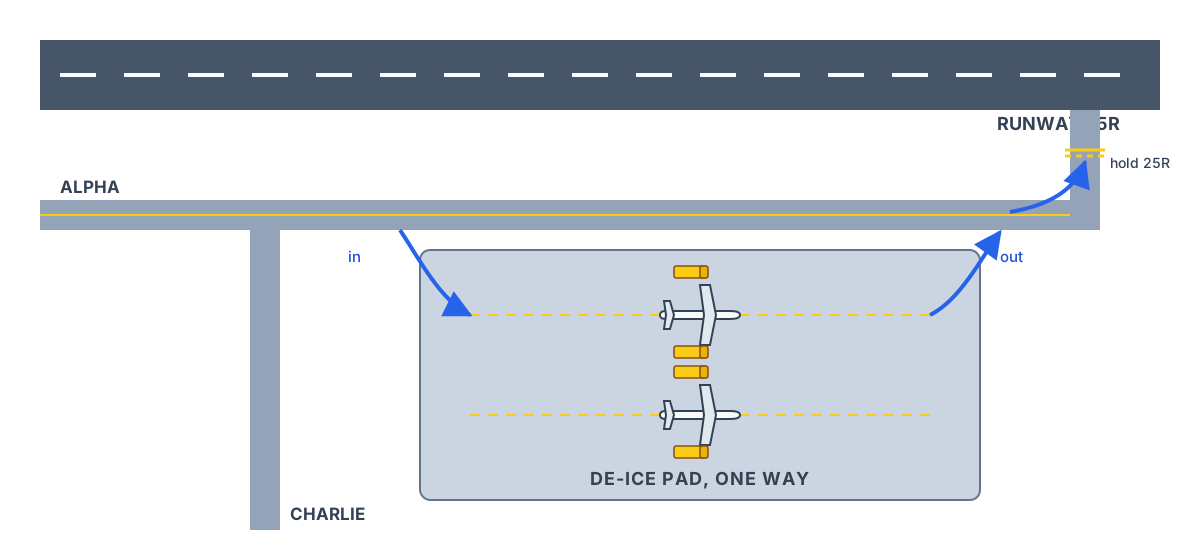
At busy airports, spraying takes place at a remote de-ice pad off the main taxiway route so glycol runoff is contained and queues do not block the ramp or the runway holding point. A departure taxis from its stand to the pad, holds in a bay while the trucks spray it, and calls ready to taxi again once treatment is complete and its holdover clock is running. From the pad exit, you clear the aircraft onward to the runway holding point.
Bayview Tower, American Two One Five, at the stand, request taxi to the de-ice pad.
American Two One Five, Bayview Tower, taxi to the de-ice pad via bravo, charlie, alpha.
Taxi to the de-ice pad via bravo, charlie, alpha, American Two One Five.
Bayview Tower, American Two One Five, de-icing complete, holdover time twelve minutes, ready to taxi.
American Two One Five, Bayview Tower, runway two five right, taxi via alpha.
Runway two five right, taxi via alpha, American Two One Five.
Routing departures through a pad reshuffles the departure order because multiple bays work side by side and larger aircraft take longer to spray than smaller ones. Once an aircraft leaves the pad, its holdover clock is ticking. The flight crew monitors the holdover time. In the tower, you sequence departures with the pad in mind and avoid holding treated aircraft on the taxiway without reason. If ground delays cause the holdover time to run out before takeoff, the crew cannot depart; they will report the expired holdover and must be routed back to the de-ice pad to be sprayed again.
Bayview Tower, Delta Eight Eight, holdover time expired, we need to return to the de-ice pad.
Delta Eight Eight, roger, taxi to the de-ice pad via alpha.
Taxi to the de-ice pad via alpha, Delta Eight Eight.
In the Sim
In ATC Simulator, snow is a choice in the Weather setting before a shift at Bayview only (San Francisco never snows), described there as below freezing with snow all shift, and is taught in Training 22, "Snow at Bayview", on the tower ladder. Snow builds on every runway while it falls, at different rates in light, moderate and heavy snow, and does not melt at that temperature; a runway with snow still on it after snowfall stops remains snowy until ploughed. Depth sets the braking action from good down through medium, poor and nil. On the ATIS the landing runway's braking action is read ("braking action poor"), and the recording gets a new information letter each time the action steps down. Worse braking lengthens landing rolls and rejected takeoffs, and at braking action nil pilots refuse to land or take off with "UnableUnable.A pilot says this when an instruction is unsafe or beyond the aircraft's capability, requiring a new clearance from you.Open in the glossary runway two five right, braking action nil". In the approach seat nobody works the snow; the airport's own ploughs keep the runways at medium.
The game never closes a runway by itself. When the runway in use reaches braking action poor, the lead truck, Snow One, calls on the tower frequency, gives the braking action and asks for the runway to be closed for snow removal. If you do not answer, Snow One asks again every three minutes; if you tell it to stand by, it asks again later. You close the runway by saying "runway two five right closed for snow removal", adding "proceed" if the trucks may go straight onto it. Three ploughs (Snow One, Snow Two and Snow Three) set out from the snow barn; if you did not say "proceed", they stop at the hold line and ask to enter the runway, and replying "approved" without a runway number also works. Asking for a second closure while the team is out draws "unable, we are still out on the field". While a runway is closed the ATIS remarks say so, and clearing an aeroplane onto a closed runway costs fifty points on the score sheet ("runway closed"). When ploughing finishes, Snow One reports "snow removal complete, braking action good, all vehicles off the runway", the runway is ploughed and reopened, and the ATIS returns to good.
While snow falls on a Bayview tower shift, every departure is de-iced at a two-bay, one-way pad before taking the runway, entering from taxiway Alpha at the entry end and leaving back onto Alpha at the exit end. Spray time depends on aircraft class, and holdover time is twenty minutes in light snow, twelve in moderate, and six in heavy. Both bays operate at once. With Ground controlThe tower position that owns the taxiways. It delivers departures to the holding point and takes arrivals back once they are clear of the runway.Open in the glossary separate, the computer ground controller sends departures through the pad automatically. With ground combined, each departure calls at its stand to request the pad, and you say "taxi to the de-ice pad via bravo, charlie, alpha"; taxing an untreated flight to the runway draws "we need de-icing first, request taxi to the de-ice pad", and a takeoff clearance is also refused until the aircraft has been sprayed. After treatment the crew calls "de-icing complete, holdover time twelve minutes, ready to taxi", and you taxi it to the runway. The flight strip shows TO PAD, DE-ICING, and then TAXI with HOT and the remaining minutes counting down; if holdover runs out before takeoff, the crew reports "holdover time expired, we need to return to the de-ice pad" and must go round the one-way pad again. To keep winter shifts focused on the tower frequency, the simulator omits pilot braking action reports, Runway Condition Codes, the "braking action advisories in effect" statement, and a separate airport operator on the telephone.