

The chapters before this one assume the plan holds. The aircraft flies the vector you give it, checks in when it should, and lands on the runway you named. Most of the time that is what happens. This chapter covers the other cases: an approach that breaks off, a pilot who cannot do what you asked, an aircraft that declares an emergency, a radio call that does not come back, and a wind shift that changes the active runway after you have built a sequence for the old one. None of these is rare. Each has a first response you can learn in advance, and this chapter takes them in turn.
Go-arounds
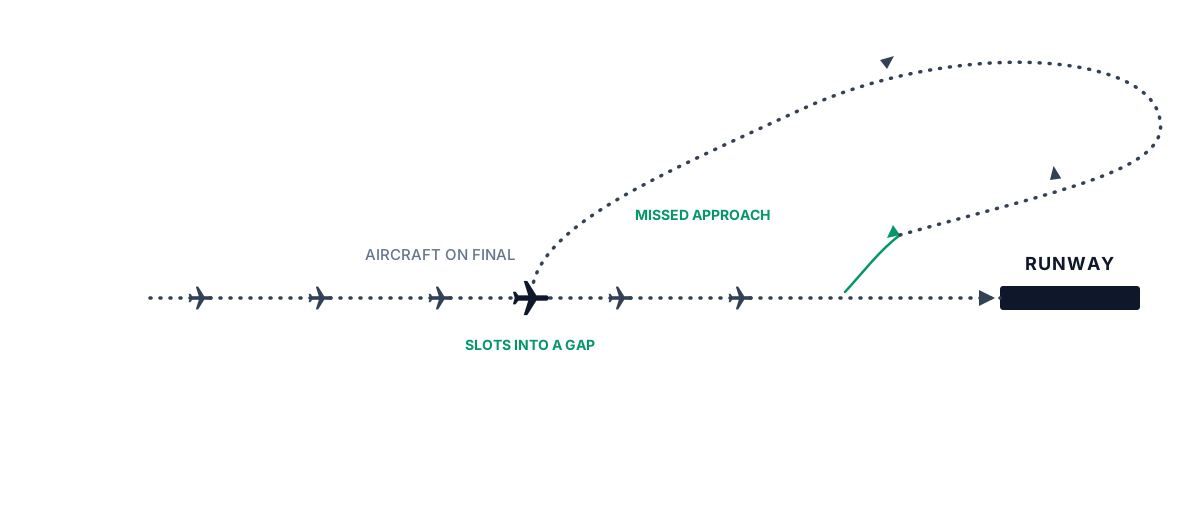
An approach can become unstable at any point on final. The aircraft may be too fast or too high, it may not be lined up with the runway, or a vehicle may still be crossing the far end. When that happens the safe course is to stop the landing and Go aroundGo around, I say again, go around.Break off the approach, climb, and fly the missed approach. The arrival's escape when the runway stops resolving.Open in the glossary. The aircraft adds power, climbs, and flies back up into your airspace. The decision is made by the pilot or by the tower controller who is watching the runway, which means the first you hear of it is often the call itself.
Bayview Approach, American Two One Five, going around, climbing through two thousand for three thousand.
American Two One Five, Bayview Approach, fly heading zero nine zero, climb and maintain four thousand, vectors for resequencing.
Your response has three parts, and they are the same every time. First, acknowledge the go-around. Second, give the aircraft a climb and a heading; usually this is the published missed approach or a vector back toward the flow. Third, work it back into the sequence. A go-around does not earn a place at the front of the line, so you put the aircraft into the first gap that fits. Keep an eye on its fuel while you do this, because a second long circuit of the pattern can turn an ordinary go-around into a minimum fuel call.
The pilot does not need a new clearance from you to begin the climb. The approach clearance the aircraft was already flying covers it:
an approach clearance automatically authorizes the aircraft to execute the missed approach procedure depicted for the IAP being flown.
A go-around is routine work. Aircraft go around every day at busy airports, and the recovery follows the same pattern each time: get the aircraft climbing and turned, then give it a new place in the sequence.
Unable
Chapter 1 introduced the word. When a pilot says UnableUnable.I cannot comply with that instruction. Information, not defiance; it forces a new plan, fast.Open in the glossary, the instruction you gave cannot be flown as given, and the word is information for you to work with. This section covers what to do with it when it comes back on your frequency.
Delta Eight Four Zero, turn left heading two seven zero.
Unable, Delta Eight Four Zero, terrain to our southwest.
Delta Eight Four Zero, roger, turn right heading zero nine zero.
The reason can be terrain, weather, the performance limits of the aircraft, or a rule the crew operates under. A pilot who says unable should give you the reason when one is available, and the pilot does not have to argue the point beyond that. Your job is to build the next instruction from what you now know. Turn the aircraft the other way, offer a different altitude, or ask what the crew can do instead. The exchange costs a few seconds and gives you an instruction the aircraft can fly.
Emergencies
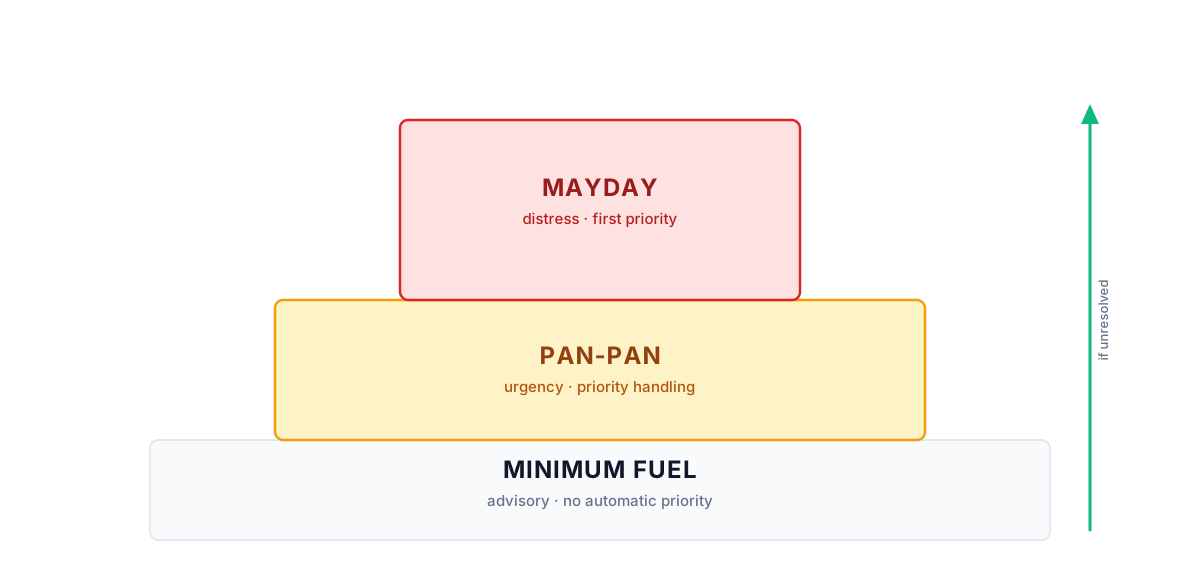
A pilot can declare an emergency in two forms, and the word the pilot uses tells you which one you have.
A pilot who encounters a Distress condition should declare an emergency by beginning the initial communication with the word "Mayday," preferably repeated three times. For an Urgency condition, the word "Pan-Pan" should be used in the same manner.
MaydayMayday, mayday, mayday.The distress call: the aircraft is in grave and imminent danger and needs priority over everything.Open in the glossary means distress. The aircraft or the people on board are in immediate danger, and the flight takes first priority over every other aircraft on your frequency.
Mayday, Mayday, Mayday, Speedbird Six One Two, engine fire, request immediate return to Bayview.
Speedbird Six One Two, Bayview Approach, roger your Mayday, turn left heading one eight zero, descend and maintain four thousand, say souls on board and fuel remaining.
Every other aircraft on the frequency gives way to that call. Give the emergency aircraft the shortest workable path to a runway, vector the other traffic clear of it, and set the rest of your routine work aside until it is on the ground.
Pan-panPan-pan, pan-pan, pan-pan.The urgency call: a serious problem, but not yet a distress. It outranks everything except a mayday.Open in the glossary means urgency. The crew has a problem that needs attention now but has not yet put the aircraft in distress. Landing gear that will not confirm down and locked is a typical Pan-Pan call, although the choice of words always belongs to the crew. The rulebook also tells you to handle anything that sounds like an emergency as an emergency, even when neither word is used. A Pan-Pan gets priority handling, and there is usually more time to work the problem before the aircraft has to land.
One more phrase sits below Pan-Pan, and it is not an emergency: minimum fuel. It tells you the aircraft's fuel has reached a point where it cannot accept a delay that would normally be no problem.
noteThis is not an emergency situation but merely an advisory that indicates an emergency situation is possible should any undue delay occur. A minimum fuel advisory does not imply a need for traffic priority.
A minimum fuel call does not by itself move an aircraft to the front of your sequence. It tells you to protect the path that aircraft already has and to avoid anything that would add delay: a hold, a long vector, or a runway change. Any of those can turn the advisory into the emergency it warns about.
Radio failure
Every transmission you send or hear has a readability. On most days you never think about it, because every call is loud and clear. When a transmission breaks up, loses words, or arrives under static, the procedure is to Say againSay again for American Two One Five.Repeat your transmission. The phrase is standard, in place of sorry or what, so it works when nothing else does.Open in the glossary: ask for the piece you missed and let the pilot send it once more.
Bayview Approach, Alaska... three three seven... [broken] ...ing through...
Station calling, say again, you are broken and unreadable.
Bayview Approach, Alaska Three Three Seven, descending through seven thousand for five thousand.
Sometimes the reply never comes. A complete loss of two-way radio contact is treated as a possible emergency in itself. The aircraft is expected to squawk seven six zero zero on its transponder and to keep flying a lost-communications procedure that both sides know in advance. For route, the pilot flies the route that was assigned, being vectored toward, told to expect, or filed. For altitude, the pilot flies the highest of three: the last assigned altitude, the minimum IFR altitude for that stretch of route, and any altitude you told the aircraft to expect. While the aircraft does this, you try every other means available to reach it. You can ask another aircraft on the frequency to relay, try a different facility, or call on an emergency channel. You do all of that before assuming the worst.
Weather and the runway change
A line of storm cells can settle across your arrival corridor at any time. When a cell blocks the path an aircraft would normally fly, the pilot asks for a deviation around it and you approve one, even when it disturbs a sequence you spent ten minutes building. The traffic keeps moving, on a longer and less direct path for a while.
Wind changes the runway in a similar way, over a longer period. Bayview lands on two five right most days. When the wind moves far enough around the compass, the active runway changes to three three, and every aircraft you have already sequenced for two five right needs a new base leg, a new final, and in some cases a new place in line. You rebuild the sequence while the push is still running, with the same aircraft you already had, and they arrive on a plan different from the one you first built for them.
In the Sim
In ATC Simulator, go-arounds happen for the same reasons they happen at a real airport: an unstable approach, a late runway conflict, or an aircraft that does not capture the glideslope cleanly. The debrief after the session records the cause, so you can see whether the go-around came from the aircraft, from the sequence, or from a call you made too late.
Emergencies are one family of scenario events. A Mayday or Pan-Pan sets a priority flag on the aircraft, the scenario tracks a deadline for getting it on the ground, and handling it well earns a scoring bonus on top of the session's separation and sequencing score. The sim also has a radio degradation model that can break up ordinary calls with static and dropped words. An emergency call is exempt from that model and stays readable while the rest of the frequency is degrading.
The wind-shift event is the runway change described above. Partway through a session the wind crosses the limit for the active runway, the ATIS on the airport information screen updates to show the new one, and every aircraft already in the old sequence has to be re-vectored onto the new runway while the session keeps running.