

The four tower chapters so far have treated the ground as somebody else's. Departures arrived at the Holding pointThe marked position at the runway entrance where a departure waits for its clearance. Crossing the marking without one is a runway incursion.Open in the glossary already taxied, arrivals left your frequency with the turn-off, and the voice that moved them across the pavement was Bayview Ground, next door. This chapter is about the hours when that voice is yours. At a small tower, and at a large one late at night, the ground position is combined with the tower position: one controller, one frequency, every aircraft on the movement area from the stand to the runway and back.
The work is the same work the ground controller does all day. What changes is that you do it between takeoff clearances and landing clearances, on the frequency the runway traffic is already using, and that the picture you keep in your head now includes the taxiways.
One controller, two positions
Ground controlThe tower position that owns the taxiways. It delivers departures to the holding point and takes arrivals back once they are clear of the runway.Open in the glossary owns the movement area: the taxiways, and the runways when nothing is landing or taking off on them. Every aircraft that moves under its own power on that surface does so on a ground instruction. The tower owns the runways in use. On a busy day the two positions sit side by side in the cab and talk to each other constantly, because a taxi route that crosses an active runway needs the tower's word before the aircraft reaches the hold line.
Facilities consolidate the two positions whenever the traffic allows. The combined controller works both frequencies or, more often, closes the ground frequency and works everything on tower. The information broadcast tells arriving crews what to expect, with a remark such as ground control combined on tower, and a pilot who calls for taxi then calls the tower and waits for a tower instruction. The rules for the ground work do not change. The same paragraphs of the manual apply, and the same ReadbackThe pilot repeating a clearance or instruction back so the controller can verify it was received correctly.Open in the glossary are required.
One rule from those paragraphs is worth learning first, because it is a habit of wording that separates ground work from everything else in this book:
Do not use the word "cleared" in conjunction with authorization for aircraft to taxi or equipment/vehicle/personnel operations. Use the prefix "taxi," "proceed," or "hold," as appropriate, for aircraft instructions and "proceed" or "hold" for equipment/vehicles/personnel.
You have cleared aircraft for approaches, to land and for takeoff. On the ground, nobody is cleared to taxi. The instruction is taxi, and the word cleared is kept for the runway so that a pilot who hears it knows a runway is involved.
The taxi clearance
A departure ready to leave its stand calls with the information letter it has and asks for taxi. Your answer has a fixed order: the departure runway first, then the route by taxiway name, then a Hold shortStop before the runway's holding position marking and do not enter. Hold short instructions must be read back.Open in the glossary instruction for every runway the route crosses. The runway comes first so that the pilot's readback of it confirms the runway assignment before the aircraft moves. The manual states the order and the words:
When authorizing an aircraft to taxi to an assigned takeoff runway, state the departure runway followed by the specific taxi route. Issue hold short instructions, in accordance with subparagraph a above, when an aircraft will be required to hold short of a runway or other points along the taxi route.
PhraseologyRUNWAY (number), TAXI VIA (route as necessary)(hold short instructions as necessary)."
At Bayview a departure at the ramp reaches the holding point for runway two five right along Bravo, Charlie and Alpha, and that route crosses no runway, so the clearance ends with the route:
Bayview Tower, United Four Four Seven, at the ramp with information Kilo, ready to taxi.
United Four Four Seven, runway two five right, taxi via bravo, charlie, alpha.
Runway two five right, taxi via bravo, charlie, alpha, United Four Four Seven.
The route is part of the clearance and is read back with it. A route you leave out is a route the pilot chooses, and on an airport with more than one way to a runway that choice can put the aircraft on a taxiway you were keeping for somebody else. Name the taxiways in the order the aircraft will use them. When the route ends on a connector that carries the same letter as the taxiway it leaves, such as Alpha One off Alpha, the connector may be left out.
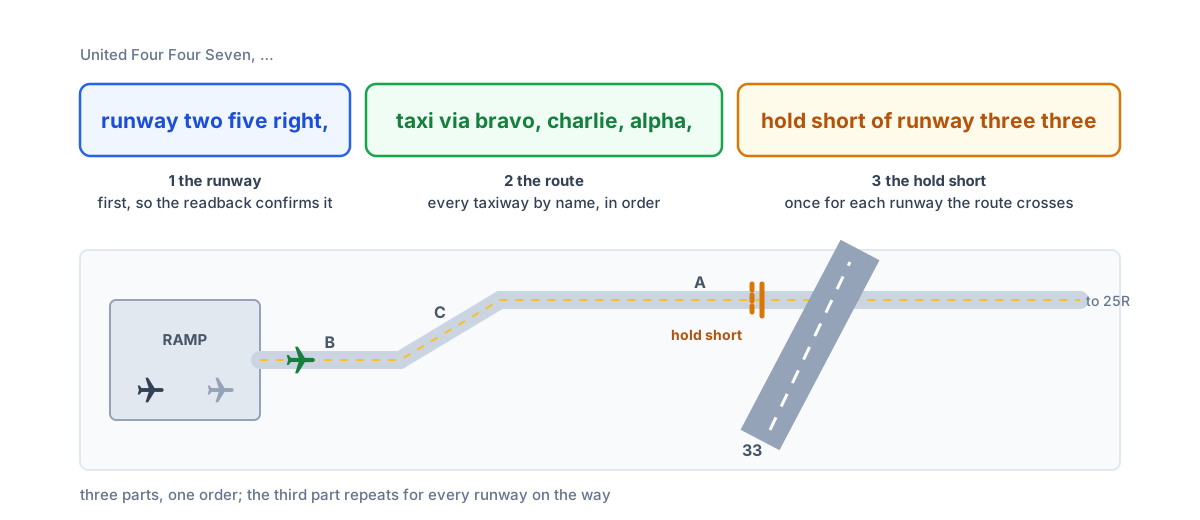
The aircraft taxis the route at a walking pace for an airliner, gives way at taxiway junctions on its own, and stops at the holding point for its runway without being told. From there the departure is the one chapter eleven taught: the ready call, Line up and waitRunway two five right, line up and wait.Taxi onto the runway and stop on the centerline, staged for an imminent departure. It is not a takeoff clearance, and pilots treat the difference as absolute.Open in the glossary if you need the time, and the takeoff clearance with the runway and the wind.
Every runway on the way
When a taxi route crosses a runway, the taxi clearance takes the aircraft as far as the hold line and no further. The crossing is a separate clearance, given when the aircraft is at the bar and you have looked at the runway it is about to cross:
An aircraft must have crossed a previous runway before another runway crossing clearance may be issued.
At Bayview the arrivals' way in from the far end of runway two five right runs along Alpha, and Alpha crosses runway three three. The taxi clearance therefore ends with the hold short, and the crossing comes later, as its own exchange:
American Two One Five, taxi to the ramp via alpha, charlie, bravo, hold short of runway three three.
Taxi to the ramp via alpha, charlie, bravo, hold short of runway three three, American Two One Five.
Bayview Tower, American Two One Five, holding short of runway three three.
American Two One Five, cross runway three three at alpha.
Cross runway three three at alpha, American Two One Five.
The hold short instruction is a mandatory readback item, with the full runway designation. A pilot who answers with RogerRoger.I received your whole transmission. It does not mean yes, and it is not a readback.Open in the glossary has not read it back, and the manual has words for that case too: read back hold instructions. Do not let a taxiing aircraft approach a runway on an acknowledgement you did not hear. Once across, the aircraft continues on the route already given, so there is nothing more to say unless you want to change it.
One habit protects you here. Before a crossing clearance, look at the runway being crossed the way chapter ten taught you to look at the runway being used: both directions, the full length, then the final. A crossing under a departure that has started its roll is a Runway incursionAnything on protected runway surface that should not be there: an aircraft past its hold line, a vehicle without approval. The accident category towers exist to prevent.Open in the glossary you caused, and the manual's rule for departures is that nothing crosses the hold line until you have seen the departure turn or pass the crossing point.
Taxiing in
An arrival leaves the runway on the turn-off you gave it in chapter twelve. With the ground combined there is no frequency to send it to, so the turn-off instruction stands alone, and the aircraft clears the runway and stops, past the hold-short markings, waiting for its route in:
American Two One Five, turn left next taxiway.
Turning left, American Two One Five.
Bayview Tower, American Two One Five, clear of runway two five right, request taxi.
American Two One Five, taxi to the ramp via alpha, charlie, bravo, hold short of runway three three.
The taxi in has the same shape as the taxi out, with the destination in place of the runway: taxi to the ramp, taxi to the stand, then the route, then the hold short for any runway in the way. The arrival is your responsibility until it is parked. On a combined frequency the taxi in competes for your attention with the next arrival on final and the departure at the holding point, and an arrival left sitting at a turn-off is the most common sign that the combined controller has fallen behind. The pilot will call again, and again, and each call is a transmission the runway traffic has to wait for.
Changing a route
A taxi clearance can be replaced at any time by a new one. To an aircraft already moving, the new route starts from the taxiway it is on; to a stopped one, it starts from where it stands. Two other instructions round out the ground work. Hold position stops an aircraft where it is, on the taxiway or at a bar, for as long as you need. Continue taxiing releases it on the route it already has, with no need to restate the route.
Delta Two Zero Two, hold position.
Holding position, Delta Two Zero Two.
Delta Two Zero Two, continue taxiing.
Continue taxiing, Delta Two Zero Two.
The manual also allows a taxi to be given one step at a time. It calls these progressive taxi instructions and issues them when a pilot asks, when construction or traffic makes the usual route unwise, or in weather that hides the taxiways from the cab. The step names the next taxiway and the way onto it: turn right on Charlie, or continue taxiing on Charlie when the aircraft is already headed that way, or continue straight ahead. The pilot turns onto that taxiway, follows it to its end, stops there and calls for the next step. A hold short can name a taxiway as well as a runway. Hold short of Alpha stops the aircraft at the junction with Alpha until continue taxiing releases it. One preposition separates two instructions here. Turn right on Charlie is a taxi step. Turn right at taxiway Charlie is the runway exit instruction from the previous chapter, and a pilot on the landing roll hears it as that.
United Four Four Seven, turn right on Charlie, hold short of Alpha.
Right on Charlie, hold short of Alpha, United Four Four Seven.
United Four Four Seven, holding short of Alpha.
United Four Four Seven, turn right on Alpha.
Right on Alpha, United Four Four Seven.
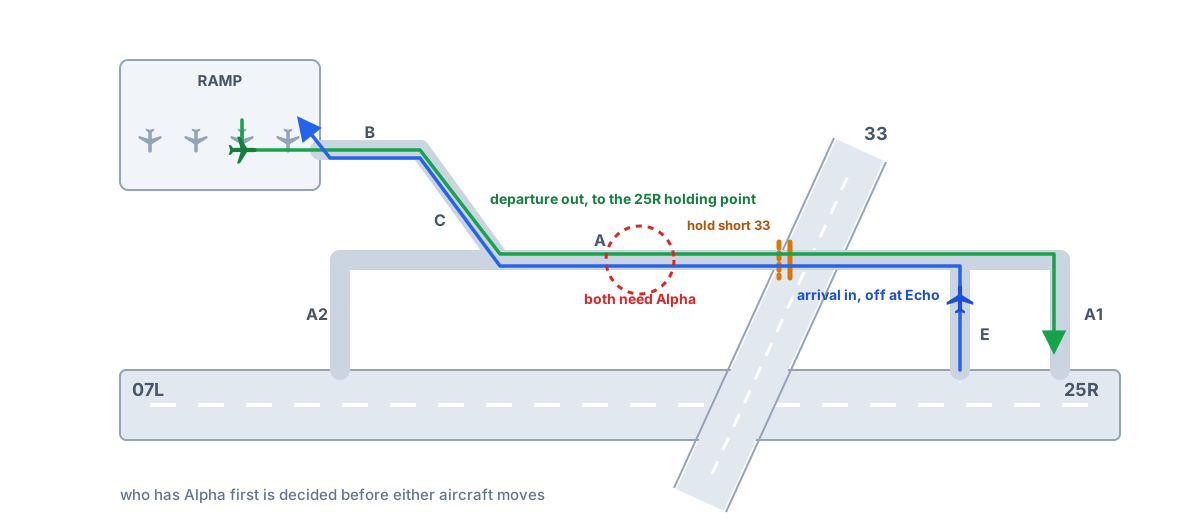
The mistake that these instructions repair is one only a ground controller can make. Two aircraft routed toward each other on the same taxiway stop nose to nose, and neither can pass. It comes from the routes you issued. The way out is a new route for one of them, turning it round on the taxiway it came in on and sending it to the junction where the routes divide. Plan the routes so it does not happen. When both a departure and an arrival need Alpha, give the departure the route first and hold the arrival at its turn-off until Alpha is clear, or send one of them another way.
In the Sim
In ATC Simulator the ground is an option on the tower shift. By default an unseen ground controller taxis departures out and arrivals in, as the earlier tower chapters describe. Choose the combined ground in the ready room and the recording gains the remark ground control combined on tower, departures call ready at their stands, and every taxi clearance in this chapter is yours to give, by voice or from the surface actions. Your readback carries the route as the pilot resolved it, so a bare taxi to runway two five right earns the field's own route spoken back to you, and a route the airport cannot follow is refused in words. Crossings are given at the bar as in the previous chapter, and every runway a route crosses is read back as a hold short whether you said it or not. Hold position freezes a taxiing aircraft where it stands, the same stop as chapter thirteen's stop, stop, stop, and continue taxiing releases it. A progressive step works as the manual describes: turn right on charlie takes the aircraft onto Charlie and to its end, where it stops and calls for further taxi every half minute until you give the next step or a full route, and hold short of alpha holds it at that junction until continue taxiing. The readback names the turn the pilot made, whether or not you said which way, and a step onto a taxiway that leaves the other way is refused in words.
The scoring follows the rest of the tower. The full form of the clearance, runway first with the route named, scores as standard phraseology. An arrival left clear of the runway without a taxi clearance costs the same ten points that a late handoff to ground cost before, and it calls every thirty seconds until you answer. Departures nobody taxis and arrivals nobody taxis in join the ground queue that already ends a neglected shift after a quarter of an hour.
The sim diverges from a working cab in four ways. Pushback and engine start belong to the ramp and are never heard on your frequency. A departure at a gate calls ready to taxi from the gate, and once you clear the taxi the ramp pushes it back onto the taxilane, where it starts its engines before it moves off on your route. Aircraft taxiing past the gate stop short while the push is under way. At a field where ground approves each push, that approval would be one more call for you. The runway is the one the flight filed for, and a taxi clearance to another runway is refused. There is no follow the Airbus and no vehicle traffic; aircraft taxi the route you gave at the manual's pace and give way at junctions on their own. And a crossing said inside a taxi clearance, which the manual allows, is heard as a hold short for that runway. The crossing itself is always the exchange at the bar. The lesson for this chapter is the nineteenth guided shift: one departure taxied from the ramp to the runway and away, one arrival landed, turned off, taxied in and crossed runway three three on your clearance.