

The tower does not schedule its arrivals. A departure waits at the Holding pointThe marked position at the runway entrance where a departure waits for its clearance. Crossing the marking without one is a runway incursion.Open in the glossary for as long as you leave it there. An arrival is descending toward the threshold at around a hundred and forty knots whether you are ready for it or not, and everything in this chapter follows from that difference. With the departure queue your job was to find gaps. With the arrival stream your job is to make decisions before a deadline that keeps moving toward you, because each arrival has a fixed time at which it will reach the runway, and the only way to change that time is to send the aircraft around, which chapter thirteen covers.
Getting an arrival down is manageable because arrivals reach you in good order. The work of chapters four through seven was done before the flight ever called you, and the cab inherits the result.
Arriving already established
By the time an arrival checks in on your frequency, approach has done everything chapter six taught. It has descended the flight, vectored it, cleared it for the approach and released it to you established on the ILS. The aircraft arrives on a known line at a known angle, spaced behind the arrival ahead by approach's sequencing, and it will follow that line to the runway without another instruction from anyone. You never vector an arrival and you never assign it an altitude. Its path across your airspace is the most predictable thing in your view. The one decision approach could not make for it is yours: whether the runway will be available when the aircraft gets there.
The check-in you learned in chapter ten is therefore a question. When a pilot reports ILS runway two five right, the flight is established and coming, and everything you say to it between then and touchdown is a form of answer. The answer is yes, not yet, or no.
The decision window
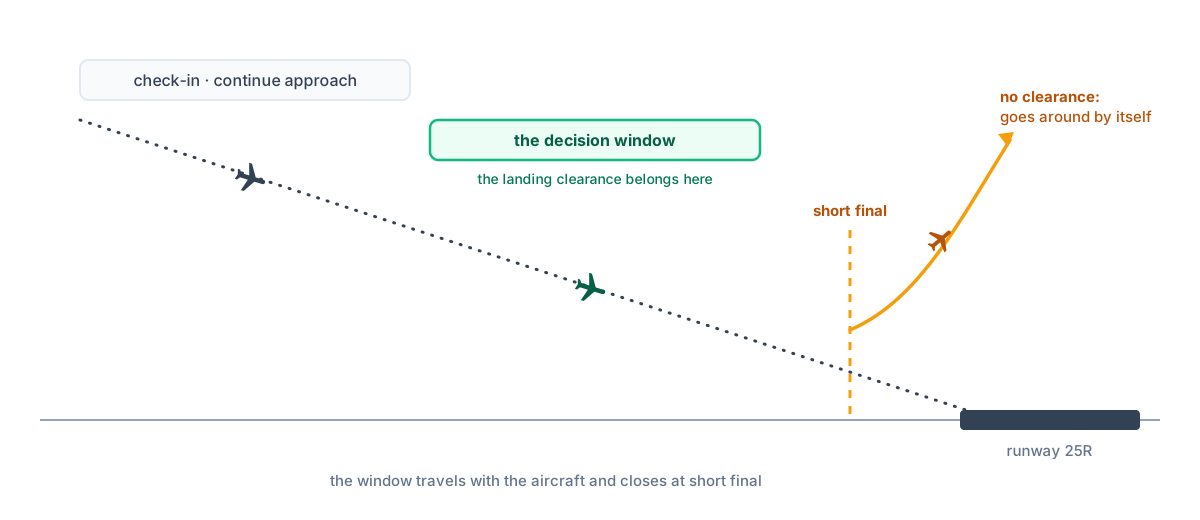
Continue approachContinue approach, wind two five zero degrees eight knots.Keep flying the approach; the landing clearance is still to come. It authorizes nothing about the runway.Open in the glossary is the not yet. It costs nothing, changes nothing about the aircraft's path, and gives you time for the runway picture to settle: a departure still rolling, an aircraft holding in position, a gap that has not opened yet. The time it gives you is limited. A pilot descending toward a runway without a landing clearance will not land without one. At short final, if the clearance has still not come, the crew goes around on their own, as they are trained to, and your arrival becomes a missed approach that you did not command.
Alaska Four Five Nine, continue approach.
Continuing approach, Alaska Four Five Nine.
The decision window is the stretch between the check-in and that short-final point, and it closes at the speed of the aircraft. A wide gap decides itself early. When the gap is tight you have to watch the runway and the final together, which is the scan from chapter ten run at its fastest. The window closes at the same time whether you feel ready or not. If you have not answered by the time it closes, you have decided by default, and the pilot goes around.
The landing clearance
The yes has a fixed form, and it is one you already know.
When issuing a clearance to land, first state the runway number followed by the landing clearance.
PhraseologyRUNWAY (number) CLEARED TO LAND.
The runway comes first for the same reason it leads the takeoff clearance. The runway number is the one element a pilot can get wrong while getting everything else right, so it is spoken first, and the ReadbackThe pilot repeating a clearance or instruction back so the controller can verify it was received correctly.Open in the glossary gives you a second chance to hear a wrong one. The wind goes in the middle when you have it, because a pilot flying the last thousand feet of an approach needs the crosswind figures more than anyone else on the field.
Alaska Four Five Nine, runway two five right, wind two five zero at eight, cleared to land.
Cleared to land runway two five right, Alaska Four Five Nine.
The element order from chapter eleven carries over unchanged: runway, wind, clearance. The two instructions share one grammar, and a pilot who hears the front of either one knows which runway the rest of the sentence is about.
Clearing one before the runway is clear
The landing clearance does not certify that the runway is empty at the moment you issue it. It is a judgement that the runway will be empty when the aircraft arrives at it, and the manual authorizes that judgement.
Landing clearance to succeeding aircraft in a landing sequence need not be withheld if you observe the positions of the aircraft and determine that prescribed runway separation will exist when the aircraft crosses the landing threshold.
This is called anticipating separation, and it is the gap judgement of chapter eleven applied in the other direction. In chapter eleven you watched an arrival close on the threshold and judged whether a departure's takeoff roll would fit ahead of it. Here you watch the aircraft ahead, which may be a landed arrival rolling toward its exit or a departure starting its roll, and judge that it will be gone by the time the aircraft you have cleared crosses the threshold. A sound judgement lets one runway serve a stream of arrivals with no time wasted between them. If the judgement turns out wrong, the aircraft arrives at a runway that is still occupied, and chapter thirteen covers what you do then.
One limit is firm. Anticipating separation and Line up and waitRunway two five right, line up and wait.Taxi onto the runway and stop on the centerline, staged for an imminent departure. It is not a takeoff clearance, and pilots treat the difference as absolute.Open in the glossary do not combine. An aircraft holding in position is not moving toward leaving the runway, and the manual forbids clearing another aircraft to land over it on the expectation that it will leave.
Off the runway and over to ground
Your responsibility does not end at touchdown, because the aircraft is still on your runway, decelerating along the same pavement your next decision depends on. It ends when the aircraft exits.
Instruct aircraft where to turn-off the runway after landing, when appropriate, and advise the aircraft to hold short of a runway or taxiway if required for traffic.
noteRunway exiting or taxi instructions should not normally be issued to an aircraft prior to, or immediately after, touchdown.
The note in that passage protects the crew. At touchdown they are braking, steering and reconfiguring the aircraft at the same time, and an instruction spoken into that workload is likely to be missed. Let the rollout settle, then give the exit and the handoff to ground in one transmission.
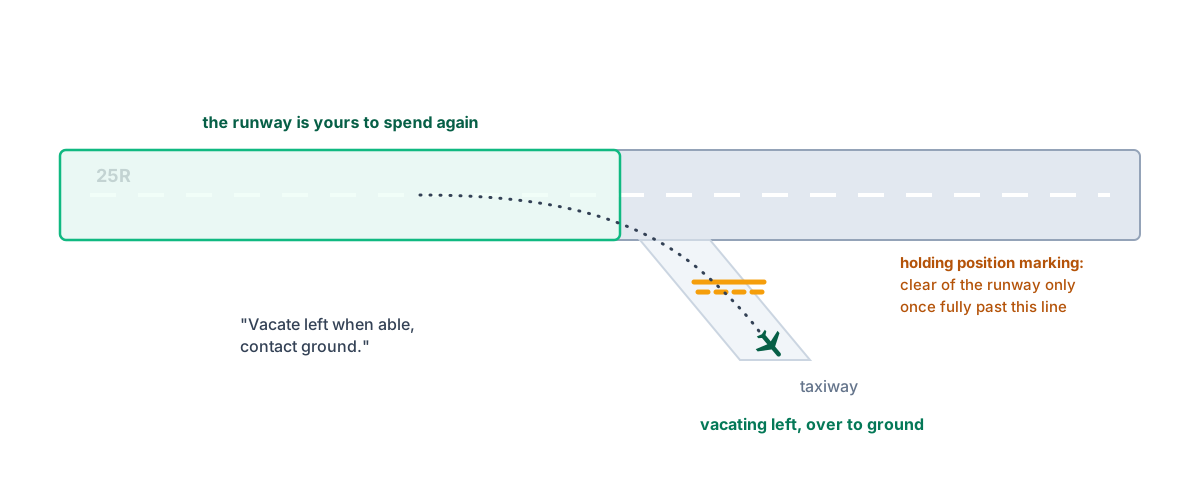
Alaska Four Five Nine, vacate left when able, contact ground.
Vacating left, over to ground, Alaska Four Five Nine.
An aircraft is clear of the runway when all of it is past the runway holding position marking, the same painted line the departure queue waits behind, and the pilot is the one who determines that. From that point the flight belongs to ground, the strip comes off your board, and the runway is available to you again.
In the Sim
In ATC Simulator, getting an arrival down follows this chapter. Approach is a computer-controlled voice that delivers every arrival established on the ILS. Each one checks in, tracks the ILS, and answers continue approach and the landing clearance in their standard forms, and the runway, wind, clearance element order is graded the same way it is for takeoffs. The strip board shows you the decision window. An arrival's strip outlines the runway reservation the flight is counting on, and the outline stays until touchdown, so a glance at the board tells you which runway is promised to which aircraft. Anticipating separation works as well. You can clear an arrival while the aircraft ahead is still rolling out, and whether the judgement was sound is settled at the threshold, as it is in a real cab.
The sim diverges from the real job in three places. An arrival you never clear goes around by itself at short final; the score does not charge you for the go-around itself. The delay it causes is counted, and it is yours to absorb. Contact ground carries no frequency, because ground in the game is a voice with no frequency of its own. The taxi to the gate is ground's, but the runways stay yours: a flight that has vacated and called ground taxis to its stand on the field's real taxiways, and if that route crosses one of your runways it stops at the holding position marking, comes back on your frequency to ask for the crossing, and asks again every half minute until you clear it across or tell it to Hold shortStop before the runway's holding position marking and do not enter. Hold short instructions must be read back.Open in the glossary. Its strip returns to your board for exactly that long.