

An aircraft that checks in on your frequency is already flying a plan. The crew filed a route before leaving the gate, that route was cleared before takeoff, and Cascade Center has flown the aircraft along it for the past hour. Most of the plan is settled by the time the flight reaches you. Your job is to read it off the data block, fit the aircraft in with everyone else headed for the same runway, and give an instruction only when the plan has to change.
This chapter covers the plan: where it comes from, what shape it takes over Bayview, and how you tell where a flight is going before you key the mic.
How an aircraft enters your sector
The check-in call sounds like the one in chapter 1. The pilot names your facility, gives their callsign, and says where they are in the descent. What is new in this chapter is the work that happened before the call. Cascade Center has cleared the flight along its filed route, started it down to an altitude that keeps it clear of your other traffic, and coordinated the handoff with you. The pilot expects you to know their route and assigned altitude already, and you do, because both have been in the data block on your scope since before the pilot pressed the button.
The handoff commits you to that plan. From the first call onward the flight is yours, and the plan it is flying is the one you inherited from Center.
Bayview Approach, Delta Four Forty, descending through one seven thousand for one one thousand, on the Ronby One arrival.
Delta Four Forty, Bayview Approach, descend via the Ronby One arrival.
Descend via the Ronby One arrival, Delta Four Forty.
Listen to what the pilot volunteers on first contact: their altitude, the direction of their descent, and the arrival they expect to fly. Each item tells you the pilot knows the assigned procedure, and together they give you an early chance to catch a mismatch between what the pilot expects and what you have cleared.
Flight plans and expected routing
Every flight operating under instrument flight rules files a route before departure. The route is a string of fixes, airways and a proposed arrival procedure, submitted to the air traffic system and reviewed before the aircraft is cleared to fly it. The filed route is the default, and Center and Approach keep the aircraft on it unless something forces a change. When a change is needed, the controller amends the existing plan.
Amending has rules. If you take a flight off its planned altitude profile, the published altitude restrictions stop applying unless you restate them. Published speed restrictions work differently: they stay in force until you delete them, vector the aircraft off the procedure, or clear it direct past them.
When route or altitude in a previously issued clearance is amended, restate all applicable altitude restrictions.
The rule matters most on a STAR, because a single clearance can carry several altitude and speed restrictions spread across several fixes. If you change the altitude without restating the crossings, the aircraft is no longer bound by altitude restrictions you may still be counting on, while the published speeds remain in force.
STARs
This section explains what a STAR is. A Standard Terminal Arrival, or STAR, is a published route from the en route structure down to an airport, agreed in advance between the airspace users and the facilities that control it. Pilots load it before the flight, and controllers assign it as part of the clearance, so nobody has to build the same path fix by fix for every arrival coming from the same direction.
The clearance must include the name and transition, if necessary, of the STAR/RNAV STAR to be flown.
Bayview has four STARs. Each is named for the fix where it begins, and all four feed runway two five right. RONBY1 crosses RONBY, then ULPEX, then MIKSA. NOLGO2 starts at NOLGO and crosses BEKRI. TISBA3 starts at TISBA and crosses ASKIL. HALME1 starts at HALME, crosses GOLPA, then joins ASKIL. The four enter from different corners of your sector and narrow toward the same final few miles.
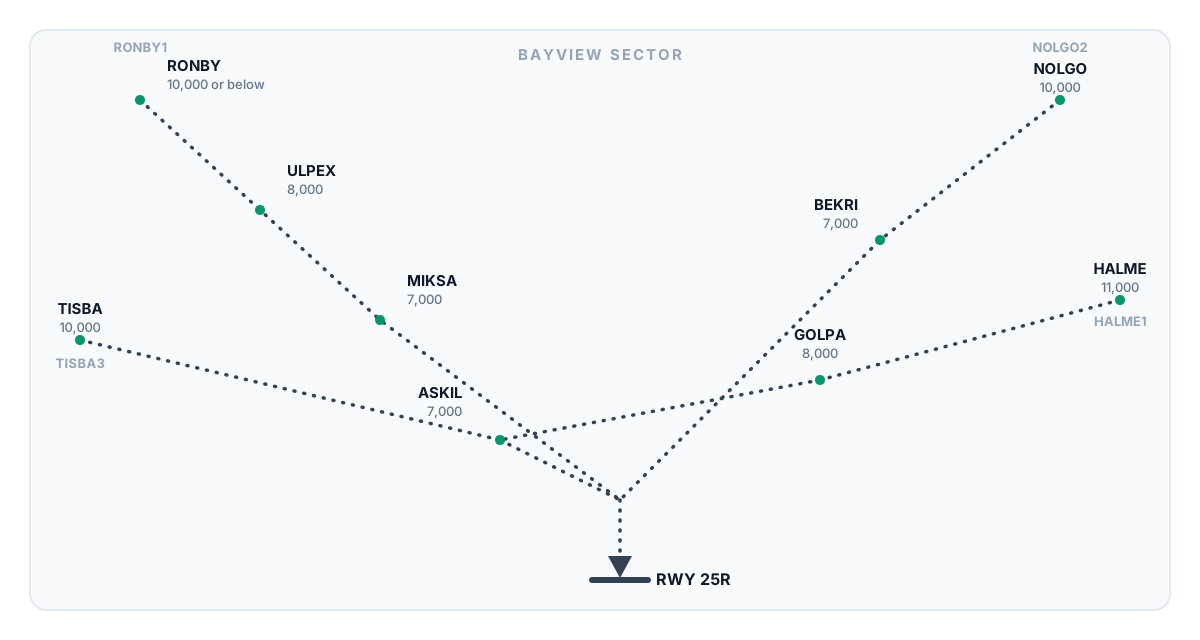
The funnel is the reason STARs exist. Without them, every arrival would need its own route built by voice from wherever it entered your airspace, and building four, ten or twenty of those while also separating everyone else is more than one controller can do in real time, so the STAR does that work in advance.
Restrictions
A STAR is more than a string of fixes. Most legs carry a restriction: cross this fix at or below this altitude, or at or below this altitude and this speed. On RONBY1 a flight crosses RONBY at or below ten thousand, ULPEX at or below eight thousand, and MIKSA at or below seven thousand and two hundred thirty knots. Those numbers keep the arrival clear of traffic on the other three STARs and clear of the terrain and airspace beneath it, and they do it without a separate crossing restriction from you at every fix.
"Descend via" is the clearance that hands those restrictions to the pilot. It tells the pilot to fly the STAR's lateral path and comply with every published altitude and speed restriction along it, so you do not read each one out over the radio. You still own the flight, and you can take it off the restrictions at any point. Until you do, the published restrictions set the altitude profile and you do not have to issue one.
- Altitude restrictions keep descending traffic separated vertically before you have to vector anyone.
- Speed restrictions keep the whole stream compressing at a predictable rate as it approaches the runway; on a STAR the most common one is two hundred thirty knots at the lower fixes.
- Route restrictions are the fixes themselves: fly this ground track, in this order.
Reading position and intent on the scope
Everything in this chapter so far is on the scope before it needs a radio call. Each data block gives you the aircraft's position, its groundspeed and track, and its altitude against the altitude it is assigned to hold or descend through. Read those together and you know where the aircraft is now and which way it is moving. If it is on a STAR, you also know which fix comes next and what restriction applies there.
The last part takes practice. An aircraft ten miles from MIKSA on RONBY1 is on a schedule. It will cross MIKSA at or below seven thousand and two hundred thirty knots in a few minutes whether you transmit again or not, because the published restriction on the STAR requires that crossing. Reading intent off the scope means you know ahead of time where a flight is headed and what it will do when it gets there.
Direct-to routing is the tool for a filed path that is longer than it needs to be. If a flight can cut a corner without crossing anyone else's path, you send it straight to a fix further along its own route.
United Nine Zero Two, cleared direct Miksa, descend and maintain seven thousand.
Cleared direct Miksa, descend and maintain seven thousand, United Nine Zero Two.
The clearance shortens the flight's track over the ground. Because it also assigned a new altitude, it replaced whatever restrictions the STAR was carrying at that point. The rule from earlier in this chapter applies here as well: when you change the plan, say what still applies.
In the Sim
In ATC Simulator, every arrival checks in already flying one of Bayview's four STARs, as Cascade Center coordinated before the handoff. The check-in call names the arrival, as Delta Four Forty did above. The data block shows the altitude and speed restrictions that arrival still has to meet, and you read them off the scope yourself.
The sim's fix-sequence procedures keep the restrictions that matter for play: the altitude and speed steps down each STAR, and the order of the fixes. A real chart carries more than that, including transitions, RNAV waypoints, holding patterns and notes for specific aircraft categories. None of those change how you work an arrival in a single sitting, so the sim leaves them out on purpose.
Direct-to is available as soon as a flight is close enough to a downstream fix on its own STAR to cut toward it. The sim scores the track miles you save the same way a real facility's efficiency numbers would. Use it to shorten a flight's path to a fix it was already going to cross.