

An ATC frequency is a party line. Every aircraft tuned to your frequency hears every instruction you give and every reply that comes back. A pilot who hears you descend the aircraft ahead, or hears the aircraft behind take a new heading, builds a picture of the traffic around them without any direct call from you. That shared listening gives every pilot situational awareness at no cost, and it works only if one station transmits at a time.
The party line
If you key up while somebody else is talking, both transmissions arrive as a squeal that nobody can make out. Listen before you press the key. If the frequency is already carrying a call, wait for it to end, even when your own traffic seems more urgent, because a stepped-on transmission reaches nobody. Keep each call short and in the expected form. Every pilot listens to the first word or two of a call to learn whether it is for them, and a short call in a standard shape can be sorted in that half second. Release the key as soon as you finish, because the other side can only answer once you let go.
The phonetic alphabet and numbers
Radio audio is narrow, compressed and mixed with engine noise. On that channel the letters B, D and E sound nearly alike, and five rhymes with nine, which are the two digits it matters most to tell apart. Aviation deals with this by never speaking a bare letter and never trusting a rhyming digit. Every letter has a word, Alfa through Zulu, and every digit has a pronunciation chosen to survive static:
Use the ICAO pronunciation of numbers and individual letters. (See the ICAO radiotelephony alphabet and pronunciation in TBL 2-4-1.)
Character Word Pronunciation 0 Zero ZE-RO 1 One WUN 2 Two TOO 3 Three TREE 4 Four FOW-ER 5 Five FIFE 6 Six SIX 7 Seven SEV-EN 8 Eight AIT 9 Nine NIN-ER A Alfa ALFAH B Bravo BRAHVOH C Charlie CHARLEE D Delta DELLTAH E Echo ECKOH F Foxtrot FOKSTROT G Golf GOLF H Hotel HOHTELL I India INDEE AH J Juliett JEWLEE ETT K Kilo KEYLOH L Lima LEEMAH M Mike MIKE N November NOVEMBER O Oscar OSSCAH P Papa PAHPAH Q Quebec KEHBECK R Romeo ROWME OH S Sierra SEEAIRAH T Tango TANGGO U Uniform YOUNEE FORM V Victor VIKTAH W Whiskey WISSKEY X X-ray ECKSRAY Y Yankee YANGKEY Z Zulu ZOOLOO noteSyllables to be emphasized in pronunciation are in bold face.
Nine is spoken 9ninerTwo syllables, so it cannot be confused with five, or with the German nein.Open in the glossary, because the extra syllable removes the rhyme with five. Three loses its final sound in static, so it is spoken 3treeSpoken tree so it cannot melt into free or be lost to a th- sound a non-native speaker does not have.Open in the glossary, and four gains a syllable and becomes 4fowerTwo syllables, so it cannot be confused with for.Open in the glossary for the same reason. Five becomes 5fifeThe soft v ending of five drops out under static, so the spoken form ends in a hard f instead.Open in the glossary. Zero is spoken zero and never "oh", because "oh" is also the letter O and could be part of something being spelled.
Numbers are normally spoken one digit at a time: one two four point six, never "one hundred twenty-four point six". That is your own frequency as Bayview Approach, and headings, speeds and frequencies all follow the same pattern. There are two exceptions. Altitudes are grouped by the hundred or the thousand, so eleven thousand feet is spoken "one one thousand", and the manual allows the plain group form, "eleven thousand", as a restatement when that adds clarity. Airline flight numbers are spoken as whole numbers, and the next section covers them. At flight levels, which chapter 2 explained, the form changes again to bare digits after the words "flight level". The pattern to carry away is digit by digit almost everywhere, grouped for altitudes and airline callsigns.
Callsigns, theirs and yours
The callsign in a data block and the callsign spoken on the radio rarely match letter for letter. A data block might read AAL215. On the air that flight uses its airline's spoken name, called a telephony, which is separate from the three-letter code, and by the book the flight number follows in group form: "American Two Fifteen". The manual also permits the digits one at a time, "American Two One Five", whenever that is clearer. This sim speaks every callsign digit by digit, so what you hear matches the data block character for character. Most telephonies are close enough to the company name to guess; a few are not, and British Airways answers to Speedbird. General aviation aircraft have no company name, so the registration serves as the callsign. A US tail number begins with N, spoken "November", followed by the rest of the registration in phonetics. N394CD is spoken "November Tree Niner Fower Charlie Delta", letters and digits both in the forms taught above.
One addition to the callsign matters particularly at an approach position. A very large aircraft adds "HeavyUnited Four Heavy, Bayview Approach.A wake-turbulence class carried in the callsign of aircraft able to take off at 300,000 pounds or more, because the wake they leave behind is a hazard to whoever follows.Open in the glossary" to its callsign on every call. Its wake can be dangerous to an aircraft following too closely, and repeating "heavy" on each transmission keeps that fact in front of everyone on the frequency, controller included. United Four Heavy identifies itself that way on the first call and on every call after it.
Your own callsign does not change during a session. On frequency you are Bayview Approach on one two four point six. Below you, Bayview Tower answers on one one eight point three, and above and around you, Cascade Center hands you arrivals and takes your departures. A facility identifies itself by its name and then its function, every time: approach, tower, center.
Initial contact
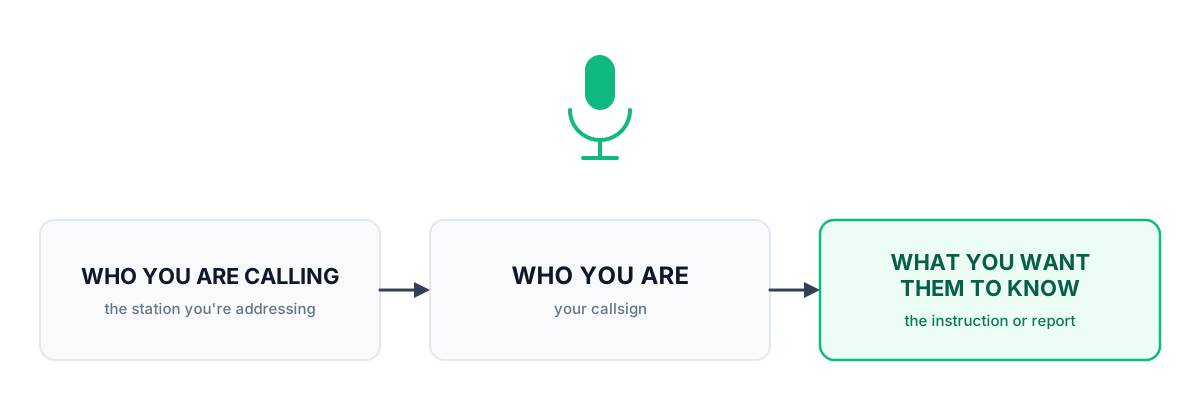
The first call on a new frequency has a fixed shape, and that shape is what makes a shared frequency workable:
Sector/position on initial radio contact: Identification of aircraft. Identification of ATC unit. Message (if any).
Say who you are calling, then who you are, then what you have to tell them. The addressee comes first because on a busy frequency the callsign is the filter: every pilot except the one being addressed stops listening after that first word. When a pilot checks in with you for the first time, the same shape runs the other way: your facility first, then their callsign, then their situation.
Bayview Approach, Southwest Eight Eight, descending through one one thousand for one zero thousand.
Southwest Eight Eight, Bayview Approach, expect runway two five right.
The check-in carries no Radar contactAmerican Two One Five, radar contact.I have identified you on my display and will provide radar flight following. Said when identification is established, and the pilot can stop making position reports.Open in the glossary and needs none. Chapter 1 explained that the phrase belongs to the first radar controller to identify the flight. Real pilots often add filler to this call, such as "with you". It is harmless, but it is not standard phraseology and it carries no information. The parts that matter are the altitude the flight is leaving and the altitude it was assigned. From this call until you send the flight to the tower, it is yours.
Readbacks and hearbacks
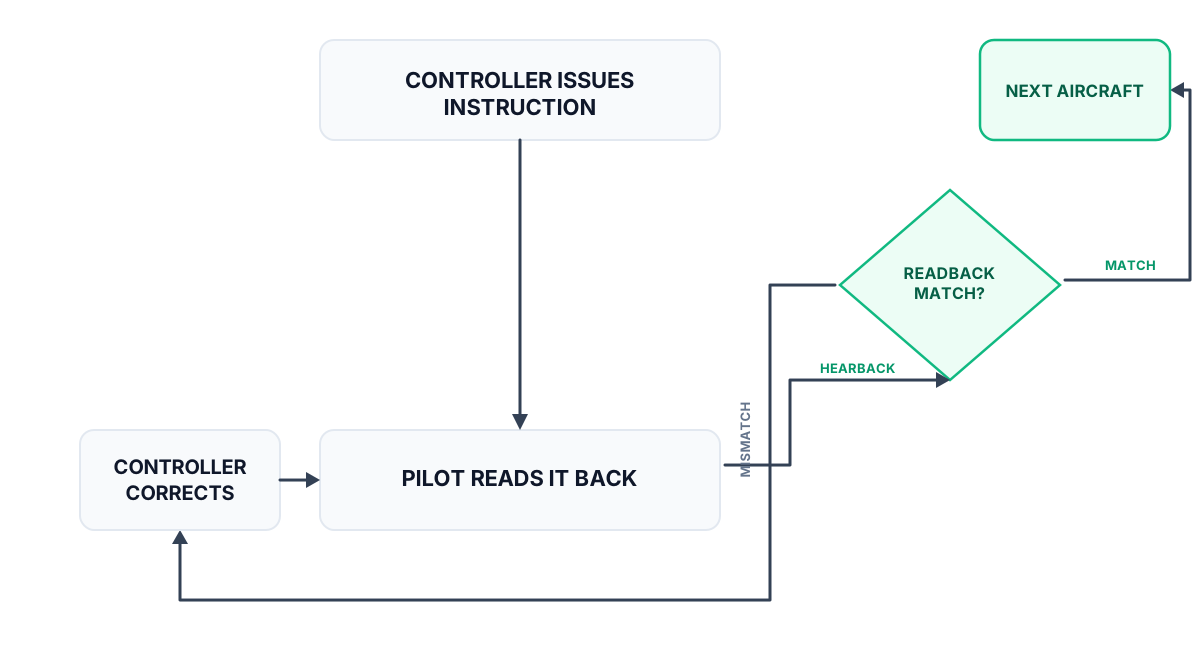
When you issue a clearance, the pilot does not answer "OK". The pilot says the clearance back to you, numbers included, and that is the ReadbackThe pilot repeating a clearance or instruction back so the controller can verify it was received correctly.Open in the glossary. Your half of the loop is the HearbackThe controller's half of the loop: actually listening to the readback and catching the one that came back wrong.Open in the glossary: you compare what came back against what you said and correct it the moment the two differ. The rulebook states this as a duty:
Ensure pilots acknowledge all Air Traffic Clearances and ATC Instructions. When a pilot reads back an Air Traffic Clearance or ATC Instruction: Ensure that items read back are correct.
A misheard clearance gets flown. A pilot who hears "five thousand" as "six thousand" levels off a thousand feet from where you put them, possibly inside airspace you have already given to somebody else. The readback puts the number into the air a second time, while it is still only words.
American Two One Five, descend and maintain five thousand.
Descend and maintain six thousand, American Two One Five.
American Two One Five, negative, descend and maintain five thousand.
Descend and maintain five thousand, American Two One Five.
The core instructions and the handoff
Most of what you say to an aircraft in the middle of an arrival is one of three kinds of instruction, each with a fixed phrase:
- Altitude: descend and maintain, or climb and maintain, followed by the number spoken as this chapter taught, as in descend and maintain five thousand.
- Heading: turn left heading or turn right heading, followed by three digits, including a leading zero, as in turn left heading zero eight zero.
- Speed: reduce speed to or increase speed to, followed by the number in knots, as in reduce speed to two one zero. The word to matters, because a bare number can be heard as an amount to slow by.
Later chapters teach when to use each of these. This chapter covers only how to say them.
Every arrival eventually leaves your frequency for the tower's. The instruction that sends it there is as short as the manual can make it: contact the next facility, and give the frequency if the pilot needs it.
United Four Heavy, contact Bayview Tower, one one eight point three.
Bayview Tower, one one eight point three, United Four Heavy.
The pilot's readback of a handoff is the new frequency and their own callsign, and nothing else. Chapter 6 covers what has to be true about the traffic picture before you may send that instruction; this chapter covers only the words.
In the Sim
In ATC Simulator the comm log is the party line in written form. Every transmission from you and from every pilot is printed in order as it happens, with a caption in dictionary spelling under each line. The radio bar shows what the game heard you say, so a command that fails to parse can be seen and said again more cleanly.
You work the microphone the way the real position does: hold push-to-talk while you speak, release it when you finish, and the other side answers only after you release. The voice parser listens for the forms taught in this chapter: niner, tree, fower and fife, the grouped altitude, and the callsign-first shape of a call. Pilots answer in the same forms, so descend and maintain five thousand comes back in the readback as five thousand. Plain English still parses if you slip, and descend to five thousand also works, but the phonetic and grouped forms are the standard the sim is built around.
Clean phraseology in these forms earns a bonus on every transmission. Readbacks are where the sim presses harder. Pilots misread a clearance now and then, at a rate set by the difficulty setting, and catching the mismatch with the correct phrase earns a bonus of its own. If you miss one, the aircraft flies the wrong number, and the debrief traces whatever follows back to the hearback that did not happen.
Real pilots misread far less often than the sim's pilots do. The rate is turned up on purpose so the habit forms before it has to hold up in the real position. Real numbers usage also goes further than this chapter: times, elevations and altimeter settings each have a spoken form of their own. This chapter covers the part used on every transmission.